If you have spent any time in high-end knife forums, you have likely run into the mythical name Rockstead. Operating out of Sakai, Japan—a city with centuries of blacksmithing lineage—Rockstead produces folders that blur the line between precision production engineering and custom master artistry.
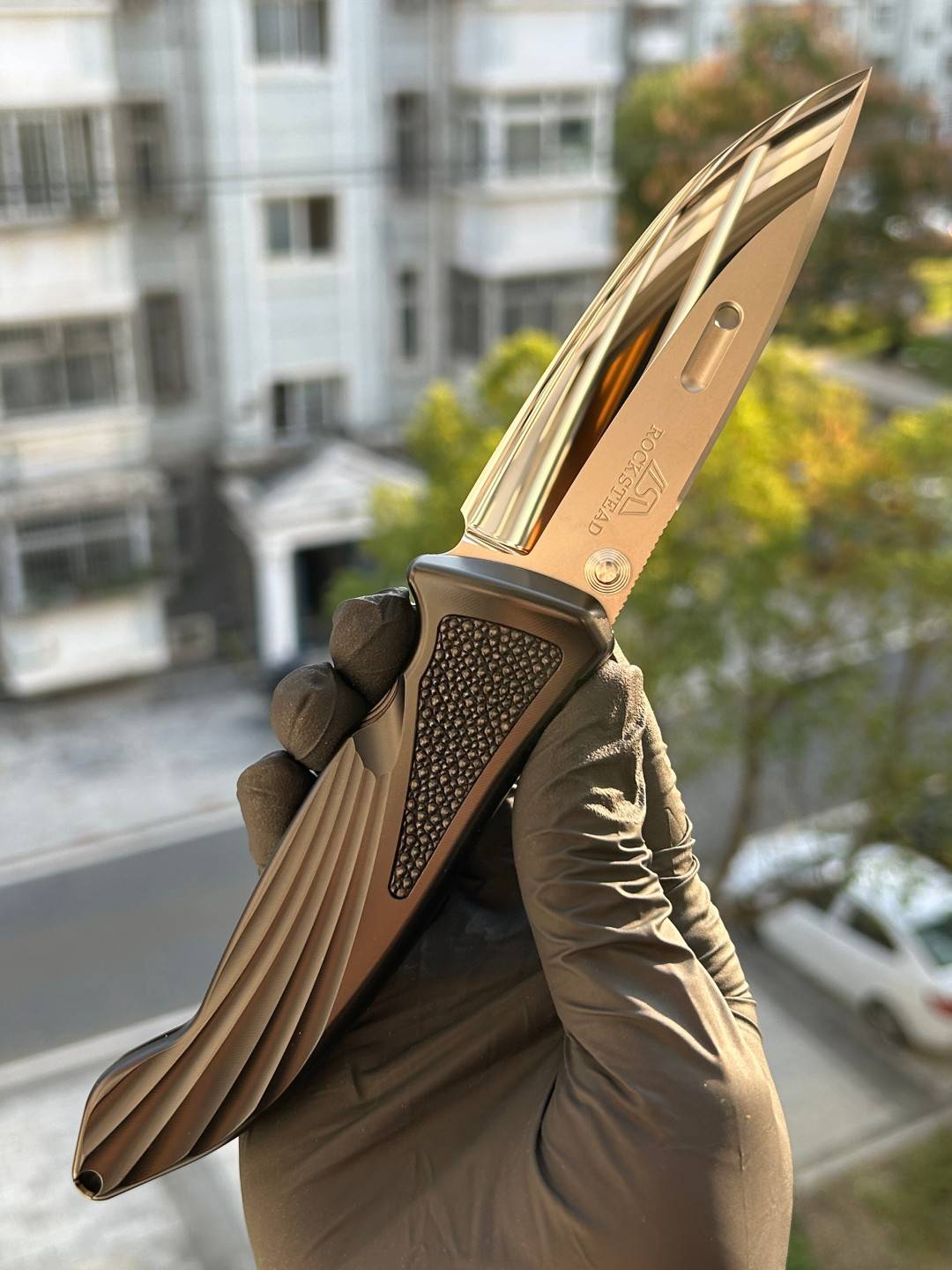
At the absolute peak of their folding lineup sits the Rockstead SHIN ZDP ZDP-189 Blade.
Named after the Japanese word for "trust" (信), the SHIN isn't a pocket knife meant to sit gently in a glass display box. Despite its jaw-dropping aesthetics, it is an overbuilt beast engineered for ruthless, long-term cutting performance. Let’s dive deep into what makes this particular blade a holy grail for collectors and serious EDC users alike.
The Heart of the Knife: ZDP-189 Powder Metallurgy Steel
The defining feature of the Rockstead SHIN ZDP is its proprietary blade construction. Rockstead utilizes ZDP-189, an ultra-premium powder metallurgy stainless steel manufactured by Hitachi Metals.
While many premium manufacturers stop heat-treating their super-steels at around 60 to 62 HRC to prevent brittleness, Rockstead pushes their ZDP-189 core to an astonishing 67 HRC.
How do they achieve this without the blade shattering? They use a clad construction technique. The hard-as-diamonds ZDP-189 core is sandwiched between two outer layers of highly flexible VG-10 stainless steel. This provides structural resilience and shock dissipation while keeping the exposed cutting edge unbelievably hard. The edge retention is otherworldly; it can clean-slice through hemp rope over 1,000 times and still maintain a hair-shaving edge.
The Honzukuri Edge: A Samurai Sword in Your Pocket
Most folding knives feature a secondary bevel—the obvious angled edge you see near the bottom of a blade. Rockstead completely abandons this convention on the SHIN, utilizing a traditional Japanese geometry known as Honzukuri.
What is Honzukuri? It is a zero-grind, dual-convex edge shape modeled precisely after ancient Japanese samurai swords.
The blade curves seamlessly from the thick spine down to a microscopically thin, zero-ground edge. This provides two massive performance advantages:
-
Unmatched Strength: The lack of an angular shoulder means there is more steel directly behind the cutting edge, reinforcing it against micro-chipping.
-
Smooth, Catch-Free Slicing: When cutting deep into dense materials, the convex shape naturally pushes material away from the blade, preventing it from binding or catching.
This flawless geometry is brought to life via an intensive hand-mirror polishing process that leaves the blade looking like chrome glass. It is so perfectly smooth that it literally reduces friction during a cut.
Ergonomics and Handle Craftsmanship
A world-class blade requires a handle that can manage its raw power. The SHIN features an ergonomic frame constructed from heavy-duty A6063 hard-anodized duralumin. The handle scales feature meticulously milled wave channels that offer a firm, locked-in grip.
To pay homage to classic Japanese craftsmanship, Rockstead inserts genuine stingray skin (samegawa) panels into the sides of the handle. This is the exact material historically used under the silk wraps of samurai swords. Beyond its aesthetic appeal, stingray skin provides an incredibly durable, high-friction grip texture that will never wear down over time.
Rockstead SHIN-ZDP Technical Specifications
| Attribute | Specification |
| Overall Length | 8.25 inches (210 mm) |
| Blade Length | 3.54 inches (90 mm) |
| Blade Thickness | 0.14 inches (3.7 mm) |
| Blade Steel | ZDP-189 Clad by VG-10 |
| Blade Hardness | Approx. 67 HRC |
| Blade Grind | Honzukuri (Dual Convex Zero-Grind) |
| Handle Material | A6063 Hard-Anodized Aluminum with Stingray Inlays |
| Lock Type | Rock-Solid Liner Lock |
| Weight | 5.11 oz (145 g) |
| Country of Origin | Sakai, Japan |
The Verdict: Is the Rockstead SHIN Worth It?
With a price tag clearing the $1,400 mark, the Rockstead SHIN is an investment. However, you aren't paying for marketing fluff; you are buying unparalleled machining tolerances, custom heat treatments, and hours of hand-executed mirror polishing. It delivers a level of smoothness and edge retention that virtually no other production folder can touch. If you want a functional piece of art that redefines what a sharp edge means, the SHIN belongs in your pocket.
Frequently Asked Questions (FAQ)
Is the Rockstead ZDP-189 blade completely stainless?
ZDP-189 features roughly 20% chromium, which classifies it as a stainless steel. However, due to its exceptionally high carbon content (around 3%), it can be slightly more susceptible to environmental pitting than standard steels like S35VN. While the VG-10 cladding provides excellent protection, you should wipe the exposed ZDP-189 edge clean after cutting acidic materials or using it in wet environments.
How do you sharpen a Rockstead Honzukuri convex blade?
Because it is a zero-grind convex edge without a traditional secondary bevel, you should never use standard sharpening stones or pull-through sharpeners, as they will ruin the mirror finish and geometry.
-
For Maintenance: Regularly strop the blade using a leather or wood paddle strop loaded with high-grit diamond paste.
-
For Major Restoration: Rockstead provides a lifetime sharpening warranty. If your blade eventually becomes dull, you can send it directly back to their workshop in Japan, where their master smiths will re-sharpen and re-polish it back to factory specifications.
Can the Rockstead SHIN be used as a hard-use EDC knife?
Yes. Despite its pristine, jewelry-like mirror finish, the SHIN is built like a tank. The thick 3.7mm spine, duralumin handle scales, and convex sword-grind mean it can handle rigorous cutting tasks without breaking a sweat. The only constraint is psychological—you must be comfortable with the inevitable cosmetic pocket scratches that come with using a grail-tier knife!