In the world of high-end cutlery, few manufacturers command the reverence accorded to Rockstead. Their knives are not merely tools; they are sculptural masterworks of metallurgy and geometry. Among their prestigious lineup, the Rockstead DON stands as a testament to the company’s philosophy of pushing steel to its absolute physical limits. Central to this performance is the use of Hitachi’s ZDP-189, a "super steel" that, when treated by Rockstead, achieves hardness levels that would leave most knifemakers hesitant.

The Metallurgy of ZDP-189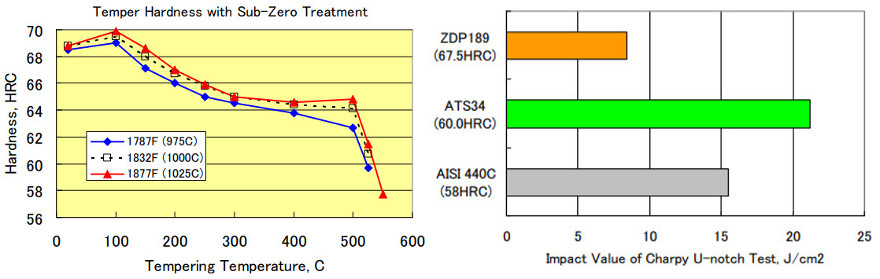
To understand the DON, one must first understand the steel that gives it life. ZDP-189 is a powder metallurgy (PM) stainless steel developed by Hitachi Metals. In the world of knife steel, powder metallurgy is the gold standard for high-performance alloys. By using a gas atomization process to turn molten metal into fine powder before sintering, manufacturers can achieve a much more homogenous distribution of carbides compared to traditional ingot casting.
ZDP-189 is famous for its extreme composition: approximately 3% Carbon and 20% Chromium. For the uninitiated, this high carbon content allows the steel to reach astounding levels of hardness, while the high chromium content provides significant, though not absolute, corrosion resistance. In standard production, ZDP-189 is often hardened to the low-to-mid 60s (HRC). Rockstead, however, famously heat-treats this steel to an incredible ~67 HRC. This level of hardness is the "danger zone"—where steel typically risks becoming as brittle as glass. Yet, through proprietary thermal processing, Rockstead manages to create a blade that is both incredibly hard and remarkably stable.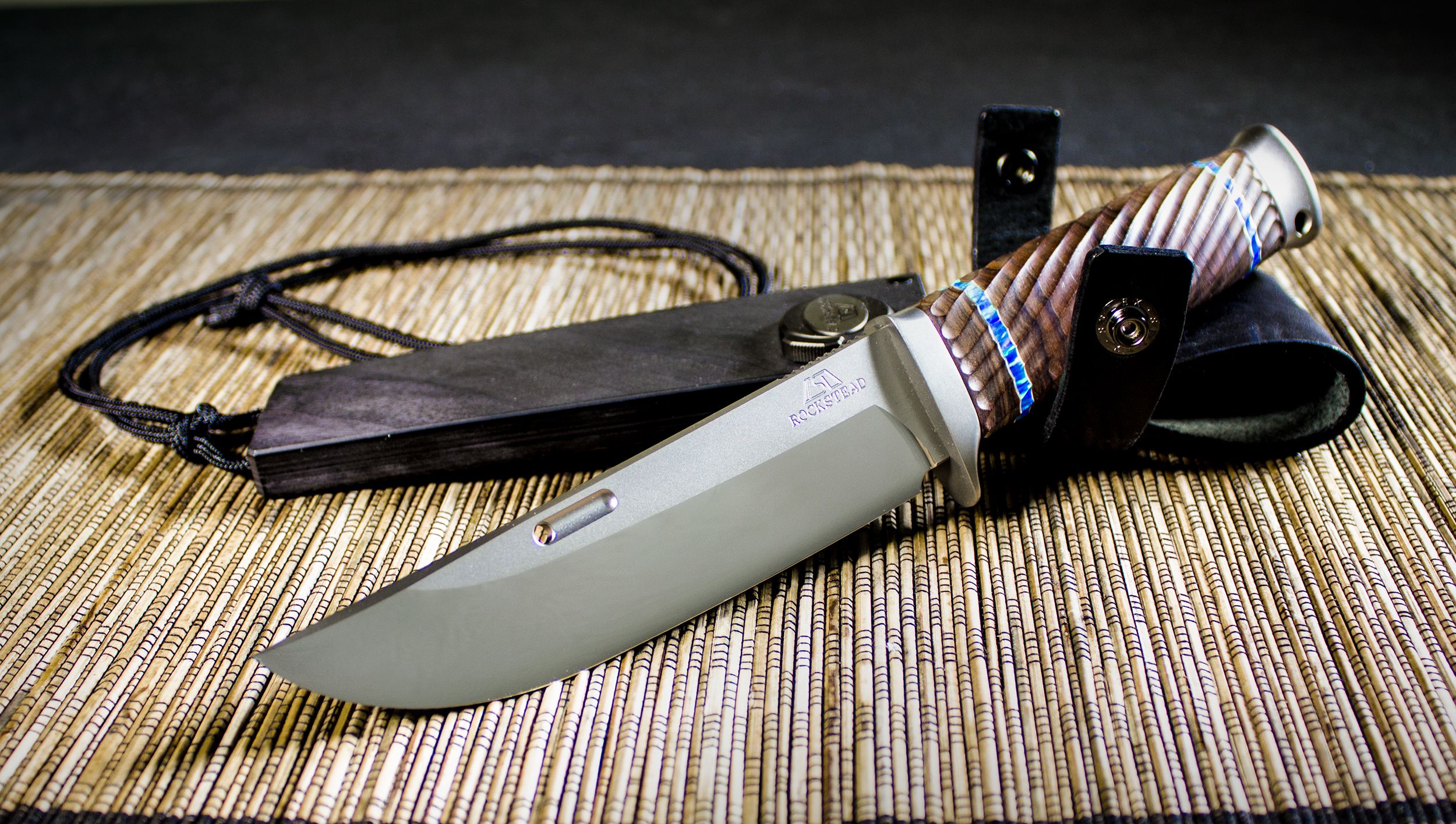
The Geometry: The Honzukuri Advantage
A common misconception in knife culture is that the steel alone dictates performance. The reality is that a super steel is only as good as its geometry. The Rockstead DON utilizes what is known as Honzukuri—a dual-convex grind.
This grind is instrumental in unlocking the potential of ZDP-189. By utilizing a convex geometry, the blade maintains a robust profile behind the edge while still allowing for a razor-thin, scalpel-like sharpness. This combination minimizes friction during cutting while providing superior structural support for the edge. Because ZDP-189 is so hard, it can hold a polished, acute angle longer than almost any other steel on the market. When you use a DON, the cutting experience isn't about "hacking"—it’s about effortless separation of material, whether you are slicing through thick cardboard or fine paper.
The "Not for Chopping" Paradigm
It is vital to address the pragmatic limitations of such a specialized blade. The product description for the DON explicitly notes that it is not suited for chopping. This is a necessary caveat of extreme hardness. When a blade is hardened to ~67 HRC, the impact resistance decreases significantly compared to a tougher, slightly softer steel like CPM-3V or CruWear.
The DON is an instrument of precision. It is designed for slicing and piercing where the force is applied in a controlled manner. To take a DON and use it to baton wood or hack at branches would be a misuse of the metallurgical choices made for the blade. It represents a trade-off: in exchange for edge retention that lasts for months of daily use, one sacrifices the ability to treat the knife like a heavy-duty axe.
Conclusion: A Masterpiece of Engineering
The Rockstead DON, with its titanium accents, ironwood handle, and ZDP-189 heart, is an exercise in engineering perfection. It is a reminder that the best knives are those that match the material characteristics to the intended use. By marrying the most advanced powder metallurgy available with a traditional, expert-level convex grind, Rockstead has created a knife that serves as both a functional cutting tool and a pinnacle of modern industrial art. For the collector and the user who demands the absolute apex of edge performance, the DON is not just a purchase; it is an entry into a higher echelon of cutting technology.