For high-end EDC (everyday carry) connoisseurs, the pursuit of the perfect pocket knife often ends with a single Japanese word: Rockstead. Operating out of Osaka, this boutique manufacturer crafts folding knives that push production machining to its absolute limits. Within their highly coveted catalog, the SHIN model occupies a legendary "sweet spot"—large enough for heavy tactical work, yet perfectly balanced for daily pocket carry. However, with the arrival of the highly limited Rockstead YOZAKURA collection, collectors now face a challenging choice: do you opt for the industrial perfection of the baseline model, or invest in the cultural luxury of the special edition? This Rockstead SHIN ZDP Yozakura vs Standard Version Price and Specs Breakdown uncovers the exact differences in cost, materials, and long-term value.

Side-by-Side Specifications Matrix
To understand the core differences between these two world-class folding knives, we must first look at how their structural elements compare on paper:
| Feature | The Standard SHIN-ZDP | The SHIN-ZDP YOZAKURA Edition |
| Blade Steel | Three-Layer ZDP189 Clad Steel | Three-Layer ZDP189 Clad Steel |
| Blade Hardness | Approximately 67 HRC | Approximately 67 HRC |
| Edge Geometry | Honzukuri (Convex Grind) | Honzukuri (Convex Grind) |
| Blade Finish | Hand-Polished Mirror Polish | Hand-Polished Mirror Polish |
| Handle Base | A7075 Aluminum | Advanced Alloy Base |
| Handle Coating | Matte Hard-Anodized Black | Optical Gradient Anodization |
| Inlay Material | Space-Grade Dry Carbon Fiber | Genuine Samurai Stingray Skin |
| Lock Type | High-Tension Liner Lock | High-Tension Liner Lock |
| Price Tier | Premium Baseline Custom Luxury | Ultra-Premium Limited Collector Tier |
Material Distinctions: Space Age vs. Samurai Legacy
While the structural dimensions, weight, and ergonomics of both SHIN variants remain virtually identical in the hand, the exterior materials tell completely different stories.
1. The Chameleon Handle vs. Tactical Stealth
The standard SHIN is a masterclass in tactical underestimation. Its A7075 aluminum frame is wrapped in a hard-anodized black finish designed to resist scratches and blend seamlessly into any dark gear setup.
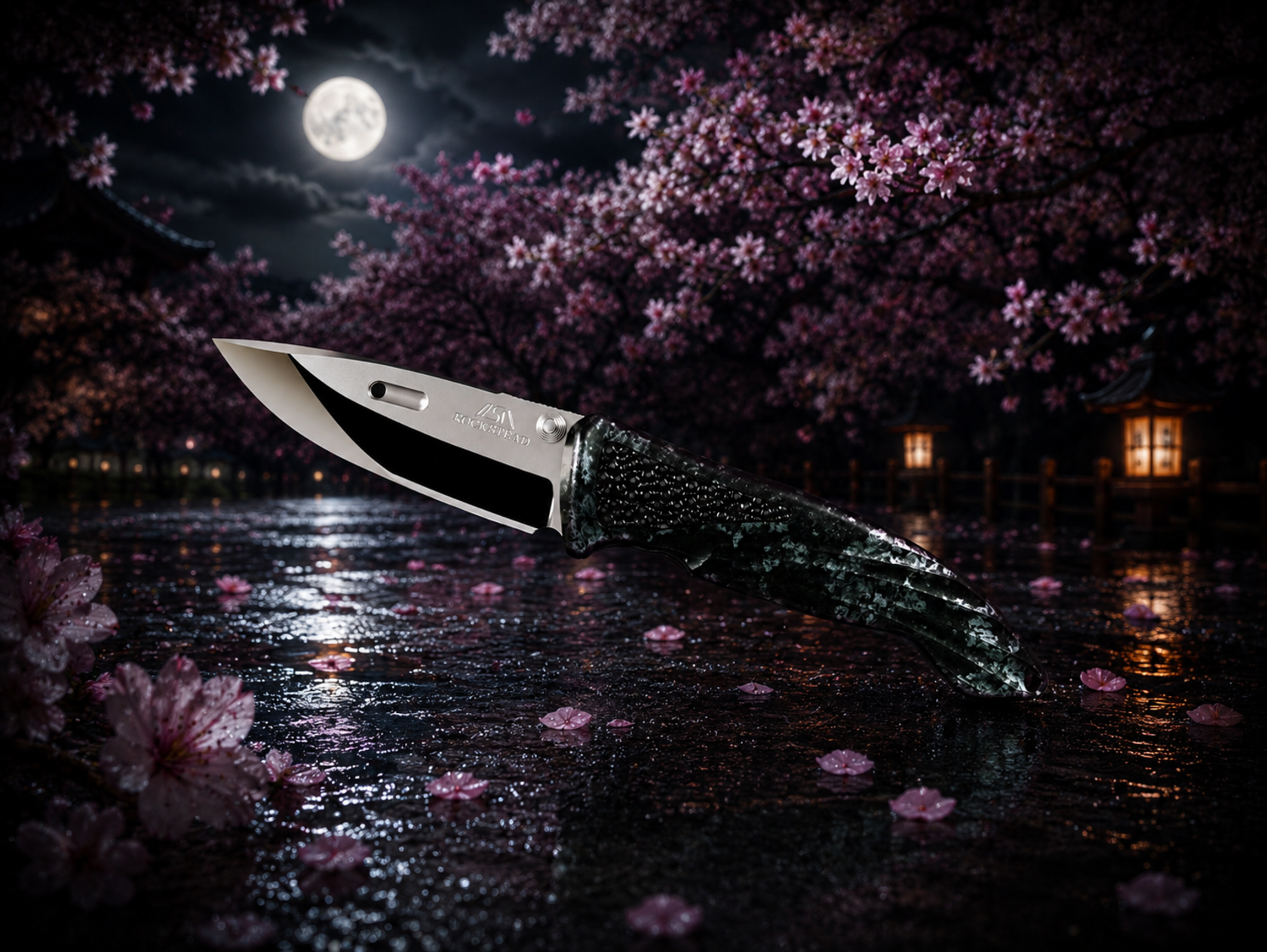
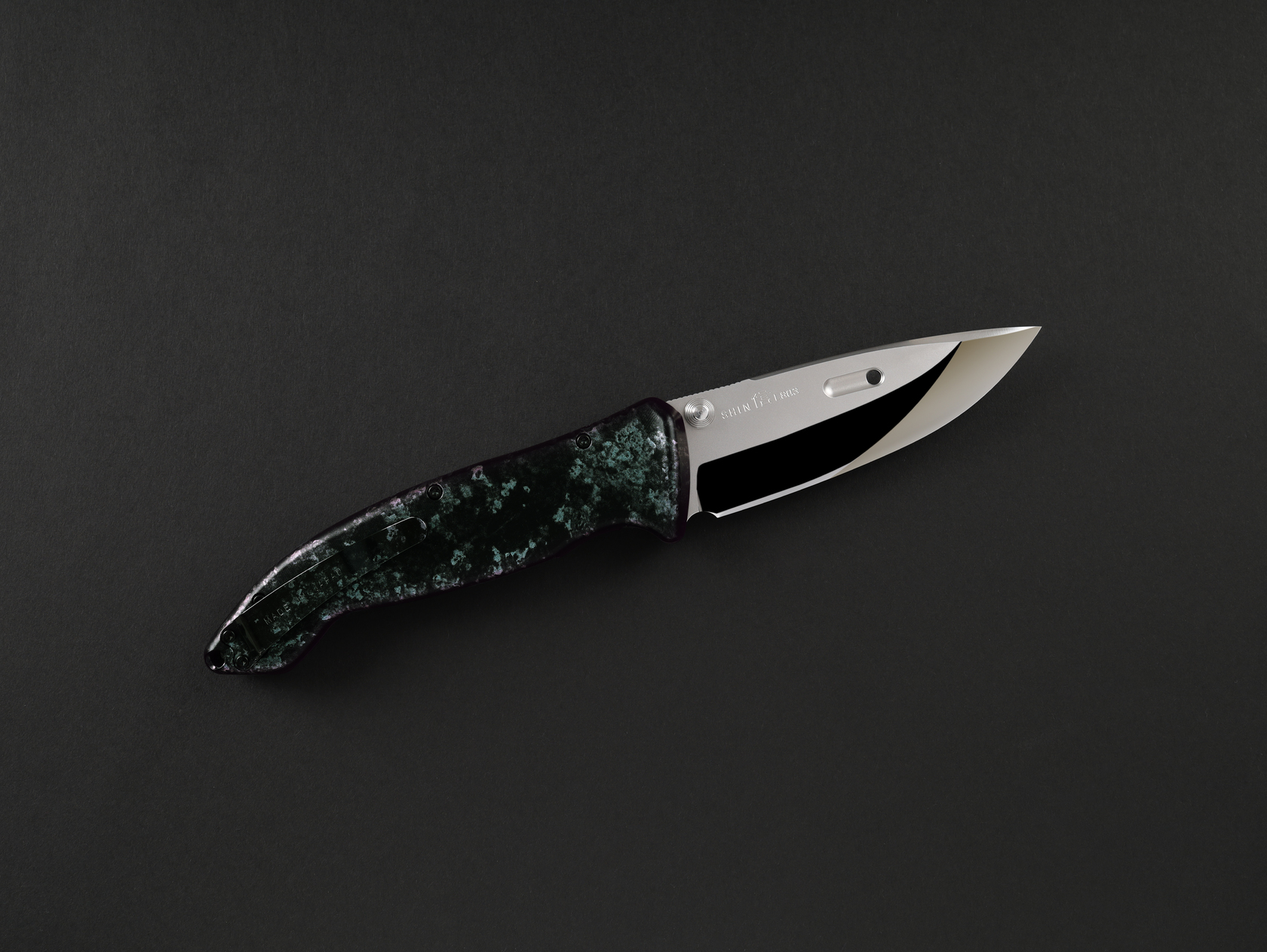
The Yozakura edition turns the handle into a canvas of shifting light. Inspired by the Japanese tradition of viewing cherry blossoms at night (Yozakura), the surface undergoes a multi-stage optical anodization. In standard indoor lighting, the handle presents a rich, deep forest green. However, when angled beneath natural sunlight, the chamfered edges brilliantly shift to reveal metallic, iridescent pink undertones.
2. Stingray Skin vs. Dry Carbon Fiber
The handle inserts create two completely distinct tactile experiences:
-
Standard Carbon Fiber: The baseline model utilizes structural dry carbon fiber inlays. This gives the knife a modern, motorsport-inspired aesthetic that feels smooth, uniform, and industrial.
-
Yozakura Stingray Skin: The special edition incorporates genuine stingray skin (Samé), the exact material Japanese armorers used on samurai sword hilts for hundreds of years. The natural, hard-pebbled texture provides a magnificent, non-slip grip that grows more secure when wet, while infusing the folder with unmistakable historical luxury.
Shared Mechanical Engineering: Uncompromising Performance
It is vital to recognize that beneath the cosmetic deviations, both versions share the exact same industry-leading cutting architecture. Choosing one does not mean sacrificing an ounce of performance.
Both iterations utilize a premium clad steel composition featuring a core of ZDP189 powder metallurgy super-steel heat-treated to an incredible 67 HRC. This ultra-hard core is permanently sandwiched between two layers of flexible VG10 stainless steel, ensuring the blade handles lateral stress without chipping.
Furthermore, both blades feature the iconic Honzukuri convex grind, which flows seamlessly from the spine to the cutting apex without a secondary edge bevel. Hand-polished to a flawless mirror polished finish, the glass-like surface eliminates microscopic friction, allowing both knives to slide through heavy cardboard, rope, and wood with zero drag.
Both folders secure their blades via a heavy-duty liner lock bar that is perfectly radiused to prevent lock stick, and both deploy smoothly on micro-polished phosphor bronze washers that resist pocket dirt and moisture.
Price and Investment Value Breakdown
The financial difference between these two tools reflects their scarcity and manufacturing complexity. The Standard SHIN-ZDP is priced as a lifetime utilitarian investment—an expensive tool meant to be carried and worked hard without guilt.
The SHIN Yozakura demands a higher premium. This price increase accounts for the extensive manual labor required to execute the color-shifting anodization uniformly, the cost of sourcing high-grade organic stingray hide, and its status as a limited run.
Final Verdict: Which SHIN Belongs in Your Pocket?
-
Go with the Standard Version if you are a utilitarian purist. If your main goal is to experience the legendary edge retention of a 67 HRC mirror-polished blade in a low-profile, blacked-out aesthetic that you can put to work every single day without checking for handle scuffs, the standard SHIN is an unbeatable choice.
-
Go with the Yozakura Edition if you are a dedicated collector or gear enthusiast who views tools as functional art. The combination of traditional samurai aesthetics, changing optical colors, and extreme limited availability makes the Yozakura an investment piece that delivers a level of pride-of-ownership few other knives on earth can match.