
When discussing high-end everyday carry (EDC) folding knives, enthusiasts often focus heavily on blade steels, heat treatments, and edge geometry. While the blade does the cutting, it is the handle that dictates your control, comfort, and safety during use. In the ultra-premium knife tier, standard handle materials like structural carbon fiber, Micarta, or standard bead-blasted titanium are the norm.
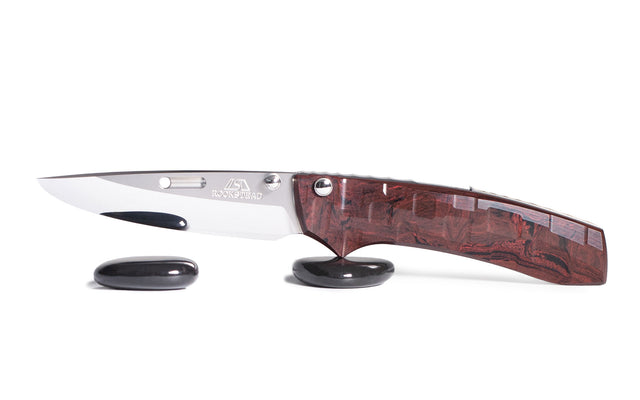
However, the Rockstead RIN completely upends industry standards. Manufactured in Sakai, Japan, the RIN features a radically innovative handle construction that seamlessly blends aerospace metallurgy with traditional Japanese artisan crafts: a DLC-coated titanium chassis embedded with Naguri-textured Ebonite inserts.
In this article, we will explore the unique chemistry, history, and ergonomics behind the Rockstead RIN’s handle materials and analyze how this avant-garde combination delivers an unparalleled level of grip comfort.

The Core Framework: DLC-Coated Aerospace Titanium
The foundational architecture of the Rockstead RIN handle consists of high-grade aerospace titanium. Chosen for its exceptional strength-to-weight ratio, titanium ensures that the knife frame remains structurally rigid and virtually indestructible under heavy mechanical pressure.
To protect the raw titanium from the inevitable scuffs and scratches of daily pocket wear, Rockstead treats the metal surfaces with a dark Diamond-Like Carbon (DLC) coating. This amorphous carbon thin-film coating is engineered at a molecular level to mimic the extreme hardness of natural diamond. The resulting finish is not only a sleek, matte black color that exudes tactical sophistication, but it also creates a surface shield that is highly resistant to scratches, chemical corrosion, and abrasive wear.
What is Ebonite? The Luxury Hard Rubber Secret
While the titanium frame provides the skeleton, the true soul of the RIN's ergonomics lies within its stunning handle scales. Rockstead chose a highly unconventional material for these inserts: Ebonite.
The Origins of Ebonite
Invented in the mid-19th century by Charles Goodyear, Ebonite is a brand name for a highly specialized type of hard rubber produced by vulcanizing natural rubber with large amounts of sulfur (typically between 25% to 30%) over extended periods. The result is an incredibly dense, rigid material that completely lacks the flimsy, soft elasticity of standard commercial rubber.
Historically, Ebonite has been highly prized by manufacturers of luxury vintage fountain pens, premium musical instrument mouthpieces (such as saxophones and clarinets), and high-end smoking pipes. Rockstead chose Ebonite for the RIN handle for several compelling reasons:
-
Thermal Regulation: Unlike metals like titanium or steel, which feel freezing cold in winter and blistering hot under the summer sun, Ebonite has very low thermal conductivity. It naturally warms to the biological temperature of your palm instantly, offering a welcoming, organic feel.
-
Chemical Inertness: Ebonite is completely non-porous and highly resistant to sweat, oils, saltwater, and mild acids. It will never rot, warp, or degrade like natural wood or bone when exposed to environmental moisture.
-
Aesthetic Patina: Over decades of use, high-quality black Ebonite undergoes minor surface oxidation when exposed to UV light and natural skin oils, developing a gorgeous, subtle dark olive or charcoal sheen that reflects the personal history of its owner.
The Naguri Texturing: Ancient Woodworking Reimagined
To maximize tactile grip security, Rockstead did not leave the Ebonite inserts smooth. Instead, they machined the surface utilizing a traditional Japanese chiseling technique known as Naguri (裂栗).
Naguri is a 600-year-old architectural art form traditionally executed by master woodworkers using specialized adzes or curved chisels. It creates a highly distinct pattern of rhythmic, undulating, wave-like scallops across the surface of wood pillars, gates, and flooring inside historic Japanese tea houses and samurai estates.
By adapting this ancient aesthetic to the Ebonite inserts of the RIN folder, Rockstead achieved a spectacular engineering feat. The convex ridges and concave valleys of the Naguri pattern match the organic geometry of human fingers perfectly. Rather than biting into your flesh with sharp, abrasive checker-pattern grooves (like modern tactical G10 or knurled titanium scales), the Naguri textures offer a soft, sweeping topography that locks into your palm securely while eliminating hot spots entirely during extended heavy cutting tasks.
Ergonomics in Motion: The Patented Movable Clip System
You cannot fully evaluate the grip comfort of the Rockstead RIN without analyzing its pocket clip. On standard folding knives, the metal pocket clip is a fixed piece of spring steel or titanium screwed into the scale. During heavy use, this clip digs uncomfortably into the user’s palm, causing painful pressure points.
The RIN overcomes this compromise by integrating a patented movable/concealable pocket clip system designed in collaboration with engineering innovator Joseph Caswell.
When the knife is riding in your pocket, the clip functions like a standard high-security deep-carry clip. However, the moment you draw the knife and wrap your fingers around the handle to apply heavy pressure, the internal spring mechanism allows the clip to shift slightly and smoothly compress flat into the handle profile. This completely neutralizes the "clip feel," leaving you with a perfectly symmetrical, ergonomically uncompromised grip that maximizes raw cutting leverage.

Conclusion: A Masterpiece of Functional Ergonomics
The handle of the Rockstead RIN is an absolute triumph of industrial design. By pairing the relentless durability of DLC-coated titanium with the organic warmth of Ebonite and the time-tested geometry of traditional Naguri textures, Rockstead has created a tool that feels less like a cold piece of machinery and more like a natural extension of the human hand.
For the premium everyday carry buyer, the RIN proves that luxury and tactical performance do not have to be mutually exclusive. It is a stunning example of how ancient Japanese artisanal wisdom can be harnessed to solve the modern ergonomic challenges of everyday carry cutlery.