When exploring the absolute apex of high-end cutlery, you will inevitably encounter Rockstead. Operating out of Sakai, Japan, this legendary manufacturer operates with precision tolerances that rival aerospace engineering, producing knives that routinely command four-figure price tags. Within their prestigious lineup, the Rockstead Sai ZDP-189 sits as a crowning achievement.
For most people, spending this level of capital on a folding pocket knife seems unfathomable. However, for advanced everyday carry (EDC) enthusiasts, metallurgy purists, and high-end knife collectors, the price tag signals a completely different tier of craftsmanship.
To determine if this Japanese masterpiece is truly a justified purchase, we must look past the luxury prestige and evaluate the raw mechanics. Welcome to our Rockstead Sai value analysis breakdown, where we will dissect the materials, geometry, manufacturing bottlenecks, and long-term asset retention to see if it is truly worth your money.

Technical Blueprint: The Foundation of Value
To accurately analyze the value of the Rockstead Sai, we must first look at the hard manufacturing specifications that separate it from standard production folders:
-
Model Designation: SAI-T-ZDP (DP)
-
Overall Length: 213 mm (8.38 inches)
-
Blade Length: 92 mm (3.62 inches)
-
Blade Thickness: 3.7 mm
-
Core Steel Matrix: ZDP-189 powdered super steel clad with VG10 (or ATS34)
-
Target Edge Hardness: ~67 HRC (Rockwell Hardness Scale)
-
Blade Profile: Honzukuri (Full Convex, Zero-Bevel Edge)
-
Blade Finish: Optically Flat Mirror Polish
-
Handle Construction: 3D-Contoured Solid Titanium with Diamond-Like Carbon (DLC) Coating
-
Lock Mechanism: Frame Lock with Hardened Steel Lock-Face Insert
1. Metallurgical Valuation: Testing the Limits of 67 HRC
Most premium folding knives on the modern market utilize excellent steels like M390, MagnaCut, or CPM-20CV. Across the industry, these steels are typically heat-treated to a hardness level between 59 and 62 HRC. This range serves as a safe compromise, keeping the blade relatively easy to sharpen for the end-user while providing respectable wear resistance.
Rockstead bypasses this standard compromise completely. By utilizing Hitachi's carbon-dense ZDP-189 powdered metallurgy steel, they push the core hardness of the Sai to a massive 67 HRC.
The Value Impact of Extreme Hardness
At 67 HRC, the microscopic structure of the cutting edge is incredibly rigid. When cutting through highly abrasive materials like heavy cardboard, industrial plastics, or thick rope, a standard knife edge quickly suffers from micro-rolling, flattening, or compression. The Sai’s ultra-hard matrix completely resists this physical deformation.
In real-world edge retention metrics, a Rockstead edge lasts roughly 4 to 5 times longer than standard premium production folders. You are investing in a tool that can be carried and used consistently for months without ever dropping below a hair-shaving factory edge.
2. The Labor Cost: The Honzukuri Geometric Grind
The vast majority of modern pocket knives are ground on automated CNC machines using flat or hollow profiles, leaving a distinct, visible V-shaped secondary cutting edge at the bottom. This V-bevel creates sharp "shoulders" right above the cutting apex, introducing drag when slicing through thick materials.
The Rockstead Sai completely rejects mass-production geometry, utilizing a proprietary profile known as Honzukuri (蛤刃 - Clam Belly).
The Honzukuri is a continuously smooth, sweeping convex profile that tapers flawlessly from the 3.7 mm spine down to a zero-bevel cutting point. This design directly mirrors the geometric cross-section found on historical Japanese samurai swords (Katanas).
The Financial Reality of the Grind
You cannot easily automate an optically straight, zero-bevel convex grind on a mass-production assembly line. It requires incredible human muscle memory, tactile feedback, and years of training. Every single Sai blade is hand-ground by a master artisan in Sakai, Japan.
When cutting, the convex geometry acts as a continuous wedge, pushing material smoothly away from the face of the blade and dropping slicing friction to near zero. Furthermore, the convex shape leaves significantly more steel mass directly behind the microscopic apex, providing the critical structural support needed to keep a 67 HRC steel from chipping. The sheer amount of highly skilled master labor required for this process accounts for a major percentage of the knife’s physical cost.
3. The Mirror Finish: Archival Engineering over Cosmetics
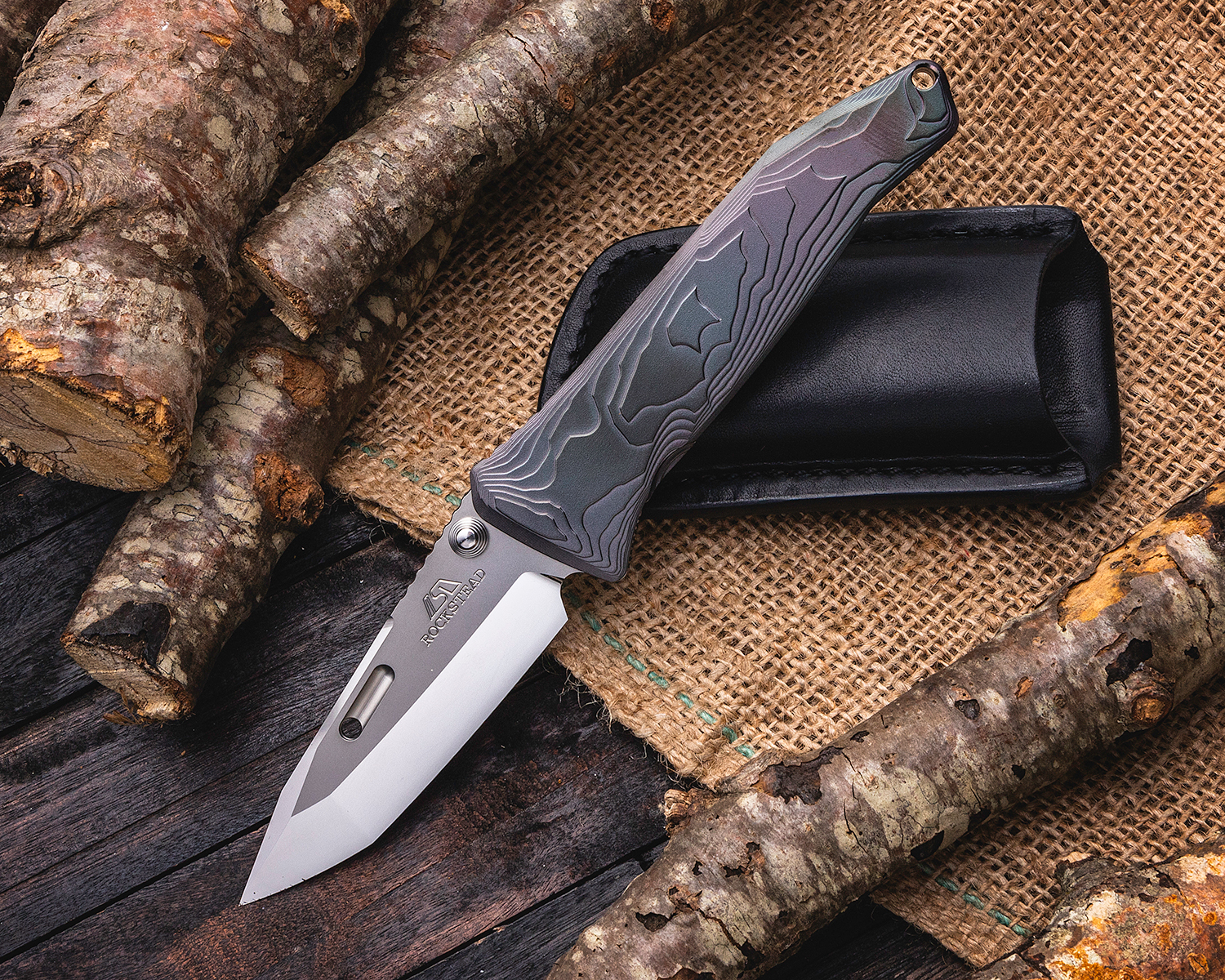
The breathtaking, distortion-free mirror finish on the Rockstead Sai is often mistaken for a purely cosmetic feature meant to attract shelf collectors. While its visual presentation is spectacular, its primary purpose is strictly functional.
Artisans manually hand-polish the blade through progressively finer grits of abrasive papers and specialized diamond compounds over many grueling hours. This process entirely eliminates microscopic surface scratches, tool marks, and grind lines.
Because ZDP-189 contains an immense amount of carbon, it is technically a semi-stainless steel. Microscopic scratches on a standard blade act as tiny valleys where moisture, sweat, and corrosive elements trap pool, initiating rust. By smoothing out the metal surface to a perfect mirror plane, Rockstead removes the physical anchor points where corrosion begins, drastically increasing the blade's resistance to environmental staining.
4. Handle Lifecycle: DLC Coating and Hydraulic Tolerances
To justify a true luxury valuation, the handle must match the lifespan of the blade. The Sai's handle scales are 3D-machined out of premium solid titanium blocks, contoured elegantly to fill the hand comfortably during use.
To protect the metal from the "snail trails" and pocket scratches that typically degrade the look and resale value of standard titanium knives, Rockstead coats the handle in a premium Diamond-Like Carbon (DLC) finish. This finish imparts a massive surface hardness to the titanium frame, ensuring your tool maintains its pristine aesthetic even after extensive pocket carry.
The opening sequence does not rely on modern ceramic ball bearings, which can accumulate pocket lint, dirt, or display dust. Instead, Rockstead relies on perfectly flat, tuned phosphor-bronze washers. The deployment feel is deliberate, heavy, and glassy smooth—often described as a "hydraulic" action. It radiates an immense sense of structural solidarity and tight internal machining tolerances.
5. The Ultimate Depreciation Shield: Lifetime Factory Backup
The biggest anxiety holding buyers back from using a high-end tool is maintenance. How do you sharpen an ultra-hard 67 HRC convex blade without ruining a flawless mirror finish? You don't—and you shouldn't try it at home.
Rockstead actively eliminates this depreciation risk by providing an unparalleled Lifetime Sharpening and Restoration Service for original owners.
Every genuine Rockstead Sai comes marked with a unique registration code. When the blade eventually requires maintenance after extended use, you simply register the knife and ship it back to their specialized workshop in Japan. Rockstead’s own master craftsmen will place the knife back onto their original grinding wheels, fully re-establishing the perfect Honzukuri convex geometry, re-polishing the mirror finish to its original distortion-free state, and returning the tool to you in absolute factory-mint condition for a nominal shipping fee.
This service acts as a complete financial safety net for your asset, ensuring that even if you use the knife hard, its value can always be fully restored by the factory.
Value Analysis Breakdown: Is It Worth the Money?
To conclude our breakdown, the value of the Rockstead Sai depends entirely on your perspective as a buyer.
The Sai is NOT worth the money if:
-
You look at a knife as a simple utility tool to open tape on shipping boxes.
-
You want a snappy, fidgety pocket knife built on fast ball bearings.
-
You want an item that you can quickly touch up yourself on a standard flat pocket stone at home.

The Sai IS absolutely worth the money if:
-
You demand the absolute technological limit of edge longevity and powder metallurgy.
-
You appreciate the integration of centuries-old Japanese sword geometry within a modern folding mechanism.
-
You seek a true flagship item that holds its collector resale value exceptionally well due to incredibly low annual production volumes.
-
You value a lifetime factory restoration program that preserves the tool’s peak performance indefinitely.
The Rockstead Sai ZDP-189 is an uncompromising exploration of mechanical boundaries. If your budget allows and you demand nothing short of absolute physical perfection in metallurgy, craftsmanship, and geometry, the Rockstead Sai is a phenomenal investment that stands entirely unrivaled in the knife world.