
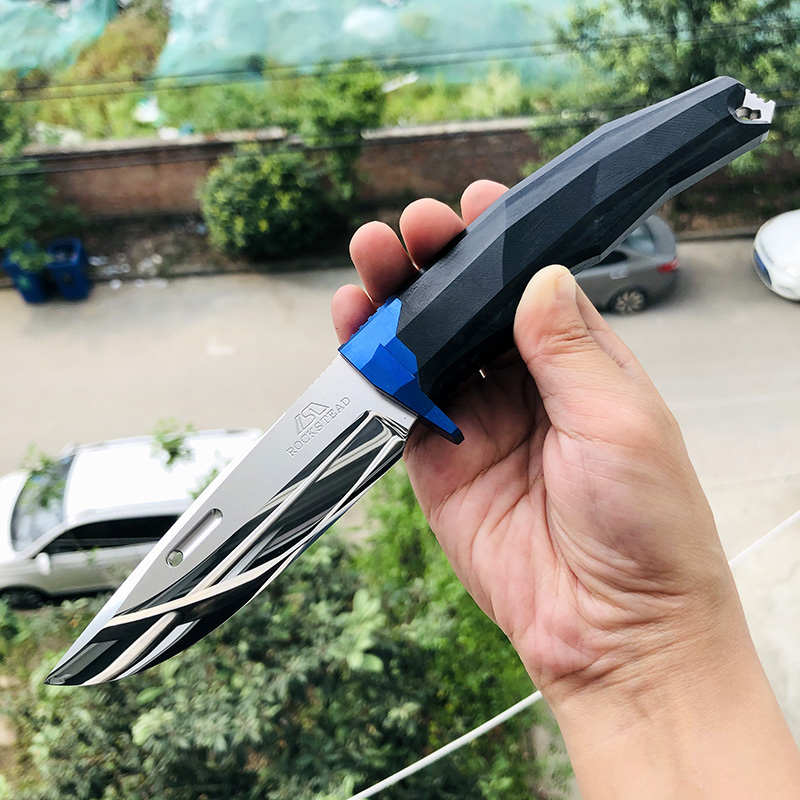
When evaluating a Rockstead knife, the conversation inevitably centers around its mind-boggling technical specifications. Rockstead doesn't just use standard cutlery steel; they push the limits of modern metallurgy and heat treatment.
If you are considering investing in the Rockstead RITSU-ZDP (BL) Fixed Blade, understanding its blade steel and hardness is crucial to appreciating its value. Below is a detailed FAQ addressing the core mechanics of what makes this blade a metallurgical masterpiece.
General Steel Composition & Architecture
Q1: What specific steel is used in the Rockstead RITSU-ZDP (BL)?
A: The RITSU-ZDP (BL) features a clad (laminated) blade construction. The cutting core is made of ZDP-189, an ultra-premium, high-carbon powder metallurgy stainless steel produced by Hitachi Metals in Japan. This core is clad on both sides by VG-10 stainless steel, creating a three-layer laminate structure.
Q2: Why does Rockstead use a clad/laminated construction instead of solid ZDP-189?
A: At its operational hardness, solid ZDP-189 would be incredibly rigid but potentially susceptible to lateral stress or brittle fracturing if subjected to sudden impacts. By cladding the ZDP-189 core with a more flexible, resilient outer layer of VG-10 stainless steel, Rockstead achieves the best of both worlds: the spine and outer flats absorb shock and lateral stress, while the core provides an uncompromisingly hard, wear-resistant cutting edge.
Q3: What is the chemical composition of ZDP-189 that makes it so unique?
A: ZDP-189 is an extreme alloy containing roughly 3% Carbon and 20% Chromium, along with substantial amounts of Tungsten and Molybdenum. For context, typical high-end stainless steels contain around 1% to 1.5% Carbon. This massive influx of carbon creates an incredibly dense concentration of hard chromium carbides within the steel matrix, which is the secret behind its unmatched wear resistance.
Hardness, HRC, and Performance
Q4: What is the Rockwell Hardness (HRC) of the RITSU-ZDP (BL)?
A: Rockstead hardens the ZDP-189 core of the RITSU to an astonishing 67 HRC (often calibrated between 66.7 and 67.2 HRC). Most premium everyday carry knives on the market operate between 58 and 62 HRC. A rating of 67 HRC places Rockstead in a specialized tier of extreme hardness achieved by very few manufacturers worldwide.
Q5: Will a blade at 67 HRC chip easily during normal use?
A: While standard steels would become dangerously brittle at 67 HRC, ZDP-189 handles it beautifully due to its advanced powder metallurgy manufacturing process, which ensures a highly uniform, micro-fine carbide structure.
Furthermore, Rockstead’s proprietary heat-treatment cycle, combined with the structural support of the outer VG-10 cladding and the robust Honzukuri (convex) edge geometry, ensures that the edge remains remarkably stable and resistant to micro-chipping during intensive cutting tasks.
Q6: How long does the edge retention actually last?
A: Thanks to the 67 HRC hardness and the concentration of chromium carbides, the edge retention of the RITSU-ZDP is legendary. Under regular, proper cutting conditions (cutting cardboard, rope, wood, or fabrics), a Rockstead edge can outlast standard premium steels like S35VN or M390 by a factor of three to five. For many users, it can go months or even years of light-to-medium use without requiring a proper sharpening session.
Corrosion Resistance & Finish
Q7: Is ZDP-189 completely rust-proof?
A: Despite having 20% Chromium, the extreme 3% Carbon content ties up a significant portion of that chromium into chromium carbides. This means there is less "free chromium" available on the surface to form a passive rust-preventative oxide layer compared to standard stainless steels. ZDP-189 is highly stain-resistant, but it is technically a semi-stainless steel.
Q8: How does Rockstead's mirror finish help with corrosion resistance?
A: The RITSU-ZDP features a flawless, hand-polished mirror finish. Beyond looking magnificent, this high-gloss finish serves a critical performance function: it completely seals the surface by eliminating microscopic pits, scratches, and grind lines where moisture, acids, and debris could settle and initiate corrosion. The mirror finish dramatically elevates the blade's practical resistance to rust.
Maintenance & Sharpening
Q9: How do I maintain the edge and finish of my RITSU-ZDP (BL)?
A: Maintenance is straightforward but requires discipline:
-
Wipe After Use: Always wipe the blade clean and dry after exposure to moisture, acidic foods, or corrosive materials.
-
Light Oiling: Apply a thin film of high-quality knife oil (like camellia oil or mineral oil) to the blade surface prior to long-term storage.
-
Stropping: To maintain the terrifying factory sharpness, avoid traditional sharpening stones for daily maintenance. Instead, use a leather strop loaded with a fine diamond paste (0.5 to 1 micron) to gently realign and polish the apex.
Q10: Can I sharpen this knife myself if it finally becomes dull?
A: Because of the extreme 67 HRC hardness and the complex Honzukuri continuous convex geometry, sharpening a Rockstead on conventional flat whetstones is highly discouraged for beginners, as it can ruin the convex profile and scratch the expensive mirror finish.
For major sharpening, it is highly recommended to utilize Rockstead’s official factory sharpening service. They have the specialized tools and expertise to restore the blade back to its exact, zero-tolerance factory laser-sharp edge while preserving the flawless mirror polish.