
In the world of premium cutlery, many manufacturers focus heavily on the type of steel they use. While steel selection is vital, true knife experts know that blade geometry dictates cutting performance. A super-steel ground poorly will underperform, but a masterfully engineered blade profile can turn a knife into an absolute force of nature.
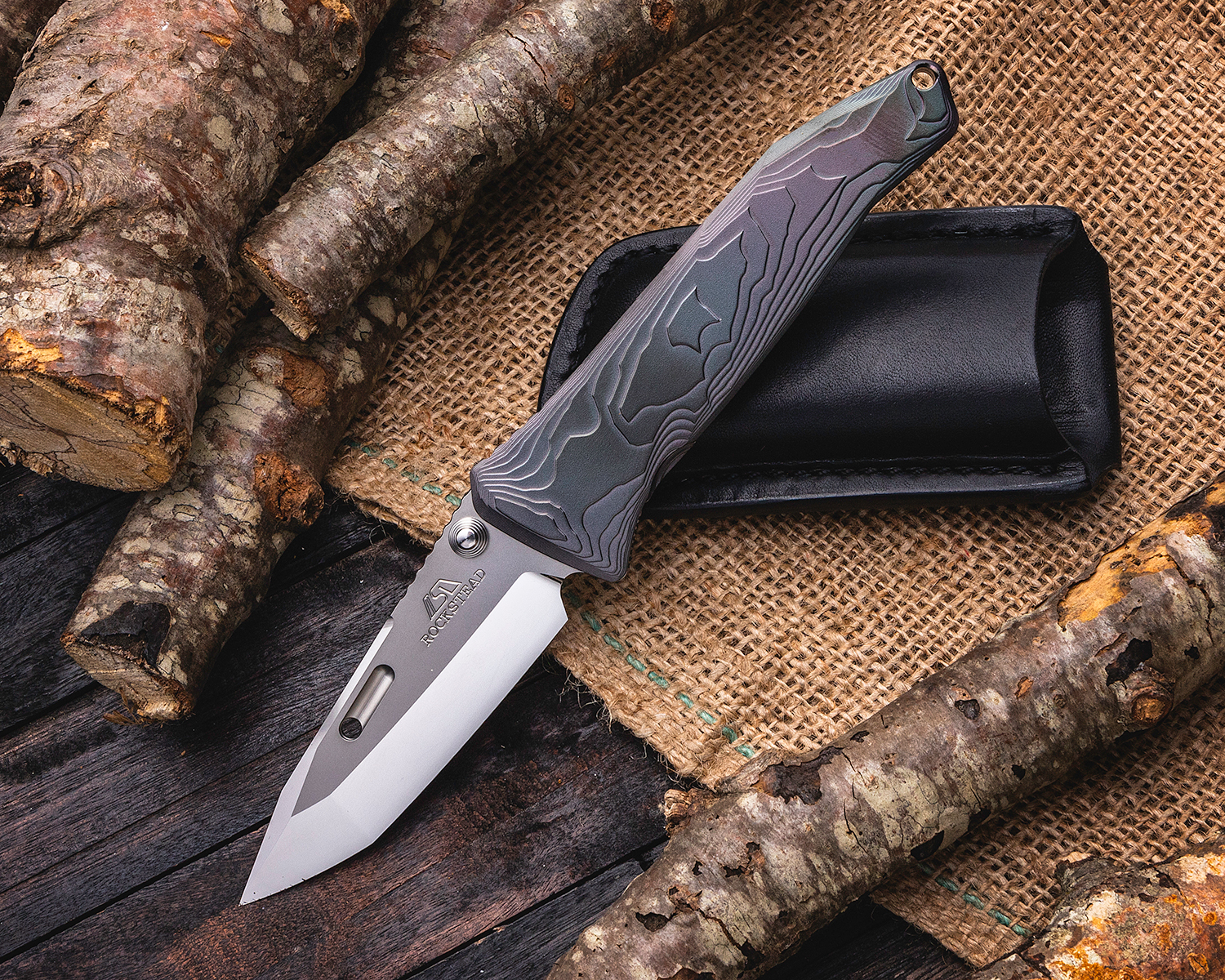
Enter the Rockstead Sai, a flagship Japanese folding knife that has achieved legendary status among everyday carry (EDC) enthusiasts and high-end collectors. While its ZDP-189 core steel is incredible, the true secret to its terrifying cutting power is its proprietary Honzukuri (蛤刃) blade profile.
In this dedicated Rockstead Sai Honzukuri blade performance review, we will break down the engineering behind this ancient edge geometry, analyze how it handles real-world cutting materials, and explain why it sets a completely new benchmark for production folding knives.

Technical Overview: The Profile of the Sai
To understand how the blade performs, we must first look at the design metrics behind the Rockstead Sai's cutting edge:
-
Blade Length: 92 mm (3.62 inches)
-
Blade Thickness: 3.7 mm
-
Blade Steel: ZDP-189 powdered super steel core, clad with a tougher outer steel matrix
-
Rockwell Hardness: ~67 HRC
-
Blade Profile: Honzukuri (Full Convex Grind with a Zero Bevel Edge)
-
Surface Finish: Micro-polished Mirror Finish
At 3.7 mm thick, the spine of the Sai is robust, built to withstand significant lateral forces. However, how that thickness transitions down to the absolute edge apex is where the magic of the Honzukuri grind takes place.
Defining the Honzukuri Geometry: The "Clam Belly" Edge
Most modern production folding knives utilize a flat grind or a hollow grind. These styles run down the face of the blade until they reach a specific point, where a secondary machine grind creates a distinct V-shaped cutting edge. This V-bevel creates sharp "shoulders" right above the cutting apex.
The Rockstead Honzukuri—which translates to "Clam Belly" or convex profile—does away with the secondary bevel entirely.
Instead, the blade features a continuously smooth, sweeping curve that tapers completely from the 3.7 mm spine all the way down to a zero-bevel apex. There are no sharp shoulders, no secondary angles, and no abrupt transitions.
This exact geometric cross-section is directly inherited from traditional Japanese sword-making techniques used to forge Katanas. Achieving an optically straight, structurally perfect zero-bevel convex edge requires incredible manual skill, as each Sai blade must be hand-ground by a master artisan in Sakai, Japan.
The Physics of Honzukuri Performance: Why It Slices Better
The continuous convex curve of the Honzukuri grind completely changes how the knife interacts with materials during a slice.
When you push a standard V-ground blade through a dense object, the material presses tightly against the flat faces of the blade, and the sharp shoulders of the secondary bevel create massive structural drag. This requires you to apply more downward physical pressure to force the knife through the cut.
With the Rockstead Honzukuri profile, the curved geometry acts as a continuous wedge. As the zero-bevel apex cleanly splits the material, the convex "belly" immediately pushes the material away from the face of the blade.
This design drastically reduces surface friction and drag. When you cut through heavy material with the Sai, it feels as though the knife is sliding through thin air, delivering a silky, effortless slicing dynamic that standard grinds simply cannot replicate.
Structural Integrity: Preventing Chips at 67 HRC
Rockstead pushes its ZDP-189 powdered metallurgy steel to an extreme hardness level of 67 HRC. In standard knife designs, treating steel to this level of rigidity makes the edge highly susceptible to micro-chipping or fracturing when it encounters hard or dense targets.
The Honzukuri geometry serves as a crucial engineering safeguard against this brittleness.
Because the blade curves outward in a convex fashion, there is significantly more steel mass residing directly behind the microscopic cutting apex than there would be on a flat or hollow-ground knife. This extra material acts as a shock absorber, distributing impact forces across a wider metallic base.
The combination of a 67 HRC core and a convex structural backing creates a fascinating paradox: an edge that is incredibly hard and holds its sharpness for months, yet remains structurally resilient against chipping.
Real-World Cutting Performance Tests
To truly evaluate the Honzukuri blade on the Rockstead Sai, it must be put to work against materials that typically destroy standard factory edges.
1. Heavy Cardboard Slicing
Cardboard is notoriously abrasive because it contains microscopic silicates and recycled debris that rapidly dull steel. During extensive cardboard slicing tests, the Honzukuri edge glides through double-walled corrugated sheets with zero snagging. Because there are no secondary shoulders to create drag, the blade cleanly sections down long panels with minimal hand fatigue.
2. Fibrous Rope and Cordage
Cutting thick hemp or marine rope requires a clean, aggressive apex. The Sai's zero-bevel edge bites into fibrous ropes instantly upon contact. The convex cheeks push the severed rope fibers outward as the blade descends, allowing the knife to pop clean through thick bundles under simple, uniform downward pressure.
3. Hardwood Whittling and Carving
When push-cutting into dry oak or cherry wood, the convex grind truly shines. Traditional V-ground knives tend to wedge themselves into deep wood grain, getting stuck. The Sai’s clam-belly shape rolls wood curls away effortlessly, allowing for deep, controlled notches without binding up in the material.
Friction Reduction Through the Mirror Finish
You cannot discuss the performance of the Honzukuri blade without mentioning its signature flawless mirror polish. Artisans manually polish the steel surface through progressive grits until all microscopic tool marks, scratches, and valleys are entirely gone.
While beautiful to look at, this mirror polish serves a vital performance objective: it eliminates microscopic friction points. A smooth, reflective metal surface slides across materials with significantly less resistance than a satin or bead-blasted blade face. Furthermore, because there are no micro-scratches to trap moisture, the stain resistance of the high-carbon ZDP-189 steel is vastly improved.
Maintenance and the Edge Lifetime Guarantee
Because the Honzukuri profile relies on a continuous, zero-bevel convex curve, it cannot be sharpened at home using standard flat sharpening stones or guided angle kits. Attempting to do so will flatten out the curve, ruining the geometry and damaging the mirror finish.
To protect the performance of your blade, Rockstead includes a Lifetime Factory Sharpening Service for original owners.
When your Sai eventually requires maintenance after heavy use, you simply register your unique knife code and ship it back to the factory in Japan. Rockstead’s original craftsmen will place the blade back onto their specialized grinding wheels, re-establishing the perfect Honzukuri convex geometry, re-polishing the mirror finish, and returning the knife to you in absolute factory-mint condition.
Final Verdict: The Peak of Cutting Geometry
The Rockstead Sai Honzukuri blade performance review proves that this knife is far more than a luxury status symbol. It is a highly optimized cutting instrument that masterfully blends ancient sword geometry with modern powder metallurgy.
If you are looking for an everyday carry folder that redefines what it means to be sharp, minimizes slicing friction, and holds an edge far longer than standard cutlery steels, the Honzukuri edge on the Rockstead Sai stands completely unmatched. It is an engineering masterpiece designed for those who demand absolute perfection from their tools.