For elite knife collectors, the acquisition strategy changes over time. Once you have acquired the foundational pieces from iconic American mid-tech brands and renowned European designers, your focus naturally shifts toward the absolute limits of mechanical craftsmanship and metallurgy. In this realm, one Japanese manufacturer commands undisputed reverence: Rockstead.
Operating out of Sakai, Japan—a city with a knife-making lineage stretching back to the era of the Samurai—Rockstead produces folders that are part aerospace engineering and part high-art cutlery. At the apex of their production catalog sits the Rockstead Sai ZDP-189.
If you are evaluating this piece for your collection, you aren't looking for a basic cardboard box cutter; you are looking for an investment-grade masterpiece. This definitive Rockstead Sai ZDP 189 folding knife review for collectors will analyze the engineering tolerances, historic geometry, market scarcity, and long-term appraisal value that make this knife an essential grail piece.

Technical Specifications: The Collector's Blueprint
An archival-grade collection relies heavily on precise manufacturing metrics. The Sai represents a highly calculated footprint:
-
Model: SAI-T-ZDP (DP)
-
Overall Length: 213 mm (8.38 inches)
-
Blade Length: 92 mm (3.62 inches)
-
Blade Steel: Core of ZDP-189 clad with VG10 (or ATS34 depending on batch)
-
Core Hardness: ~67 HRC (Rockwell Hardness Scale)
-
Blade Profile: Honzukuri (Convex, Zero-bevel)
-
Blade Finish: Perfect, Un-distorted Hand-Mirror Polish
-
Handle Composition: 3D-Contoured Titanium with Diamond-Like Carbon (DLC) Coating
-
Locking Mechanism: Frame Lock with Hardened Steel Lock-Face Insert
1. The Historical Soul: Honzukuri Convex Geometry
From a collector’s perspective, a knife must tell a story through its design. The Rockstead Sai does this via its legendary Honzukuri (蛤刃 - Clam Belly) blade grind.
While 99% of modern production and custom folding knives rely on a flat, hollow, or saber grind paired with a distinct V-shaped secondary cutting bevel, Rockstead looks to historical Japanese sword-making. The Honzukuri is a continuous, completely smooth convex profile that runs from the spine down to a zero-bevel apex.
This is the exact geometric cross-section utilized on ancient Japanese Katanas. Grinding a flawless convex edge with no secondary bevel requires incredible human muscle memory and tactile feedback. Each blade is hand-ground by a master artisan in Sakai, ensuring that no two blades are structurally identical, adding an intrinsic "semi-custom" value to every single piece that leaves the workshop.
2. The Metallurgical Apex: ZDP-189 Clad Steel at 67 HRC
In high-end collecting, a piece must possess a feature that pushes beyond standard industry boundaries. For Rockstead, that boundary is the heat treatment of Hitachi's ZDP-189 powdered metallurgy super steel.
While premium brands heat-treat their super steels (such as MagnaCut, M390, or S90V) to a respectable 60 to 62 HRC, Rockstead pushes the core of the Sai to a mind-boggling 67 HRC.
The Engineering Feat of 67 HRC
Typically, hardening steel to this extreme makes it as brittle as glass, rendering it useless for actual cutting tools. Rockstead bypasses this limitation through a two-fold solution:
-
Proprietary Heat-Treatment: A highly guarded, multi-stage thermal cycle that optimizes carbide distribution.
-
San Mai Cladding: The ultra-hard ZDP-189 core is jacketed (clad) between layers of more ductile steel (like VG10). This creates a laminate blade where the core provides an immortal cutting edge, while the outer layers absorb lateral shock and impact.
For a collector, owning a blade stable at 67 HRC is akin to owning a mechanical watch with a tourbillon—it is a proof-of-concept marvel that showcases the absolute limits of modern materials science.
3. The Flawless Mirror Polish: The Art of Reflection
The finish on a Rockstead Sai is the first thing that captivates anyone who beholds it. It is not a machine-buffed shine; it is a true, optically flat mirror finish (Mirror Finish).
Artisans manually run the blade through progressively finer grits of abrasive papers and custom diamond pastes. The process is so intense that all microscopic grid lines, tool marks, and surface variations are entirely eradicated. When you look into the flats of a Sai blade, the reflection is perfectly sharp, without any of the wavy distortion seen on lesser "mirrored" production knives.
Beyond the breathtaking shelf-presence this grants your collection display, it serves an archival function. By smoothing out the microscopic valleys where moisture and airborne elements settle, Rockstead drastically minimizes the threat of corrosion on this high-carbon steel, ensuring the blade maintains its pristine state across generations.
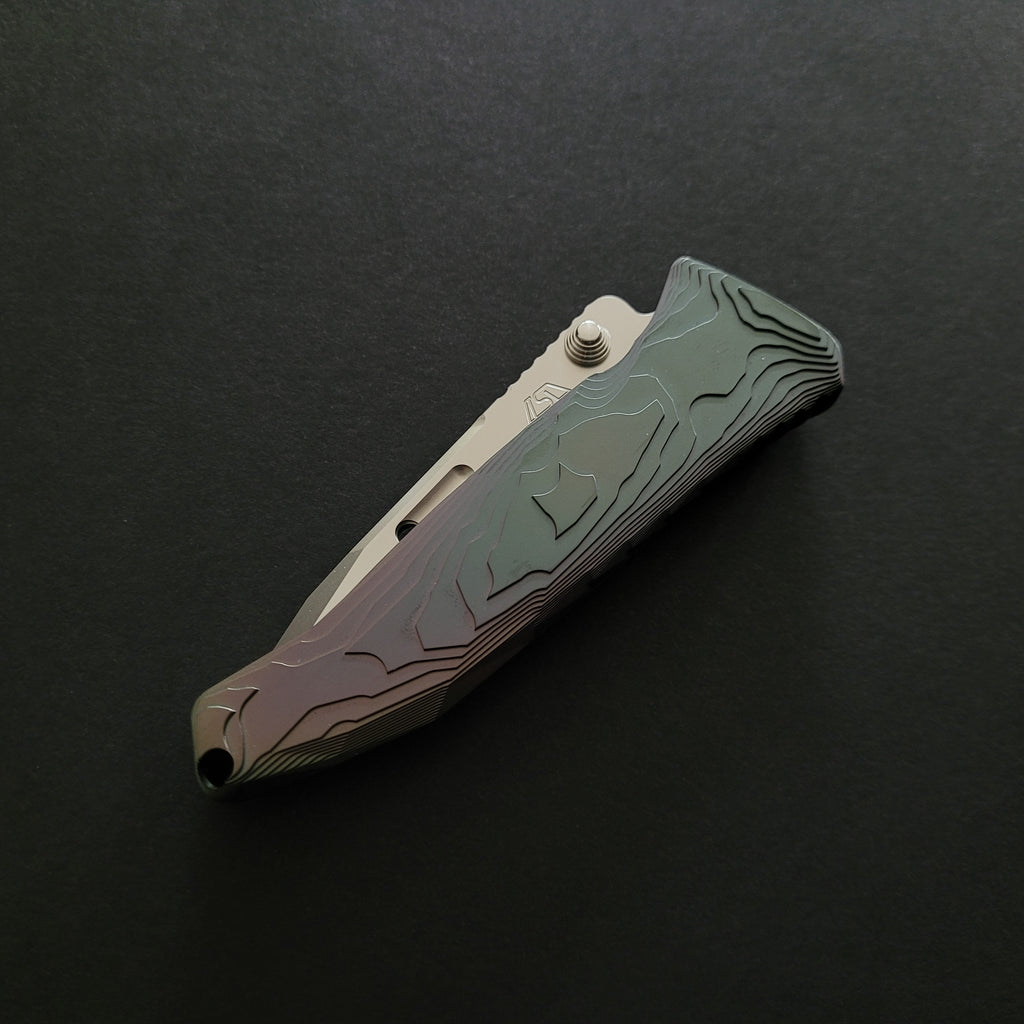
4. Aerospace Ergonomics: The DLC Titanium Handle
The frame of the Sai matches the obsessive engineering of the blade. The handle scales are 3D-machined out of solid blocks of titanium, detailed with elegant ergonomics that fill the hand beautifully.
To protect the handle from the standard wear, handling marks, and "snail trails" that plague regular bead-blasted titanium collector knives, Rockstead covers the scales in a premium DLC (Diamond-Like Carbon) coating. This application imparts an incredibly high surface hardness to the handle, meaning you can handle, admire, and display your piece without fearing that casual contact will ruin its mint condition.
The action is deliberate and hydraulic. Rockstead avoids modern ceramic ball bearings, which can accumulate pocket lint or display shelf dust. Instead, they use perfectly flat, tuned phosphor-bronze washers, creating an incredibly smooth, vault-like opening sequence that speaks to precise internal machining tolerances.
5. Proven Market Scarcity and Appraisal Value
From an investment standpoint, the Rockstead Sai ticks every box required for long-term value retention:
-
Low Production Volume: Rockstead is a small facility. They do not mass-produce these items by the tens of thousands. The manual labor required for the mirror polishing and Honzukuri grinds creates an intentional production bottleneck.
-
High Secondary Market Demand: Because global demand consistently outpaces the slow supply out of Japan, the Sai routinely holds its retail value—and occasionally commands a premium—on high-end knife exchange forums and auction houses.
-
The Lifetime Restoration Clause: Every authentic Rockstead knife comes with a unique registration code linked to the original owner. Rockstead offers a lifetime factory sharpening and re-polishing service. If your piece ever suffers minor handling blemishes, it can be shipped back to Japan to be fully restored to factory-mint condition by the original artisans, safeguarding your financial investment.

Final Verdict: Why the Sai belongs in Your Collection
The Rockstead Sai ZDP-189 is a masterwork of modern industrial art. It bridges the gap between ancient Japanese sword-making philosophy and cutting-edge industrial metallurgy. It doesn't compete with standard production knives because it operates on an entirely different plane of execution.
If your collecting philosophy centers on acquiring pieces that represent the absolute pinnacle of what humanity can achieve within a specific medium, the Rockstead Sai is not just an option—it is an absolute necessity for your grail display.