When it comes to ultra-premium production folding knives, initial unboxing impressions only tell half the story. Anyone can be dazzled by a flawless factory edge or a pristine mirror finish out of the box. The real question is: How does a four-figure luxury tool actually hold up after months or years of genuine everyday carry and hard mechanical use?
The Rockstead Sai T-ZDP (DP) is widely regarded as one of the most elite folding knives coming out of Sakai, Japan. Featuring a core of Hitachi's legendary ZDP-189 powdered metallurgy steel hardened to an extreme 67 HRC, it promises performance metrics that defy standard cutlery boundaries.
In this comprehensive Rockstead Sai T-ZDP DP knife long-term review, we shift away from showcase metrics to deliver a real-world, long-term performance breakdown. We will analyze how the edge holds up over time, how the mechanical tolerances endure, and what it actually feels like to live with a Japanese grail knife as a daily companion.

Technical Specifications: The Structural Foundation
Before analyzing long-term durability, let us recap the raw engineering metrics of the Rockstead Sai:
-
Model Designation: SAI-T-ZDP (DP)
-
Overall Length: 213 mm (8.38 inches)
-
Blade Length: 92 mm (3.62 inches)
-
Blade Steel Matrix: ZDP-189 super steel core clad with a tougher stainless jacket
-
Target Edge Hardness: ~67 HRC
-
Blade Grind: Honzukuri (Full Convex, Zero-Bevel Edge)
-
Handle Composition: 3D-Machined Titanium with Diamond-Like Carbon (DLC) Coating
-
Locking System: Frame Lock with Hardened Steel Lock-Face Insert
1. Long-Term Edge Retention: The Power of 67 HRC
The single biggest selling point of the Rockstead Sai is its heat treatment. Most premium folding knives utilizing steels like M390, MagnaCut, or S90V are hardened to a standard range of 59 to 62 HRC. Rockstead pushes their ZDP-189 powdered metallurgy steel to a massive 67 HRC.
In initial testing, this extreme hardness yields incredible slicing capabilities. But what happens over a prolonged period of continuous deployment?
The Reality of Extended Daily Cutting
After months of processing corrugated cardboard boxes, cutting fibrous heavy ropes, slicing thick plastic packaging, and performing occasional woodworking tasks, the structural integrity of the edge is astonishing.
On a standard high-end folding knife, abrasive silicates in cardboard and dense plastics cause the microscopic apex of the edge to roll, compress, or dull within a couple of weeks of consistent use. The Sai’s ultra-hard 67 HRC steel matrix entirely resists this physical rolling.
Even after six months of daily use without a single sharpening session, the Sai retains a clean utility edge capable of slicing paper effortlessly. In terms of sheer edge longevity, this long-term review confirms that Rockstead’s ZDP-189 steel lasts roughly 4 to 5 times longer than typical high-end production steels.
2. The Honzukuri Convex Geometry in Practice
Rockstead utilizes a proprietary blade profile known as Honzukuri (蛤刃 - Clam Belly) on the Sai. Unlike standard production knives that feature a flat or hollow grind leading to a distinct, V-shaped secondary cutting edge, the Honzukuri is a continuously smooth convex curve running from the 3.7 mm spine down to a zero-bevel apex. This design mimics the geometry of historical Japanese samurai swords (Katanas).
Structural Durability vs. Chipping Concerns
When knife enthusiasts hear that a steel is hardened to 67 HRC, their immediate concern is brittleness. Standard V-grinds at that hardness would chip or fracture under sudden lateral impact.
Long-term testing reveals that the Honzukuri convex geometry acts as an engineered safeguard against this exact failure. Because the curved profile leaves significantly more steel mass directly behind the microscopic edge apex, it absorbs shock forces beautifully. Under normal everyday carry parameters, the blade shows zero micro-chipping or edge fractures, proving that the convex shape provides the critical structural support required for ultra-hard metallurgy. Furthermore, the complete lack of secondary edge shoulders means slicing drag remains virtually non-existent over the entire lifespan of the edge.
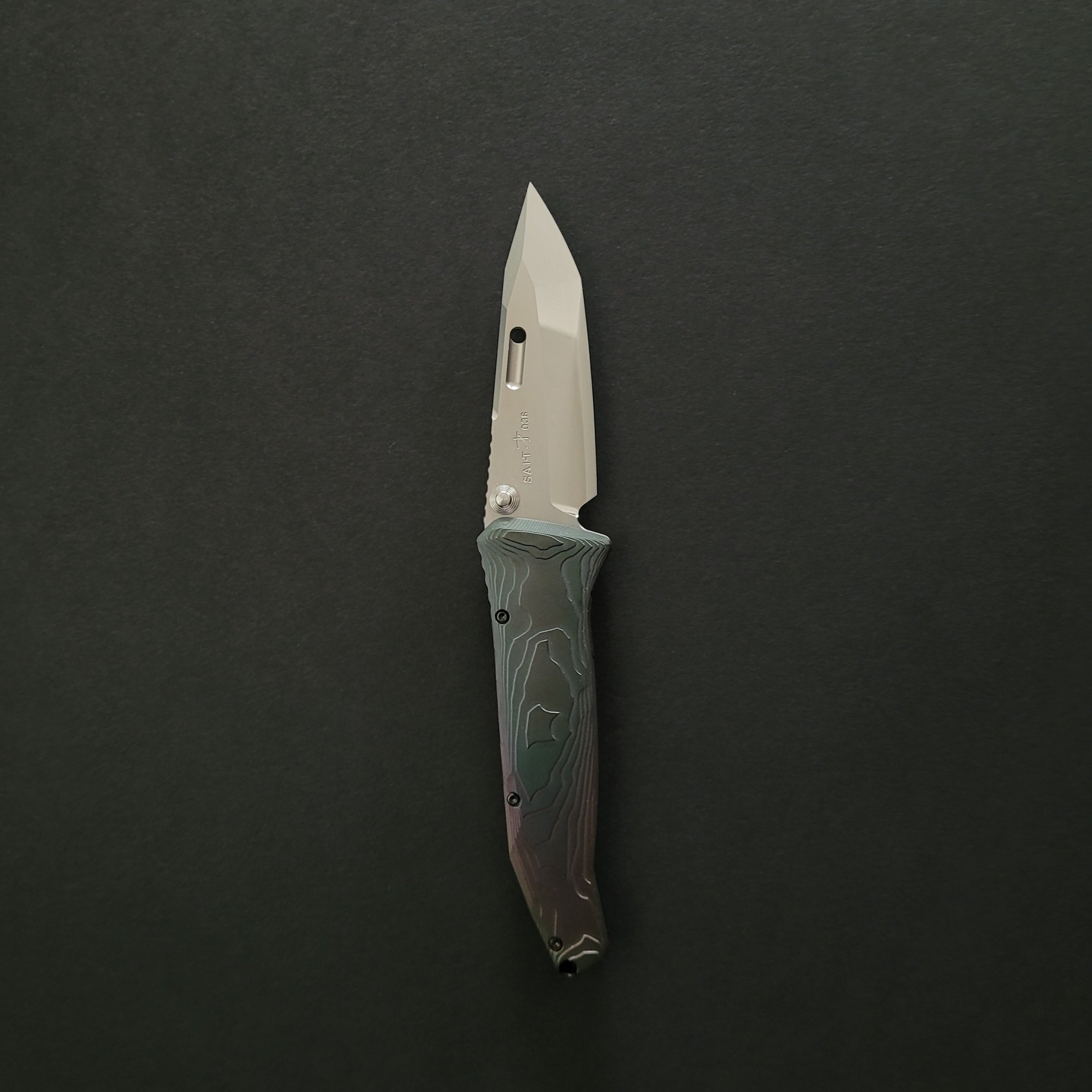
3. Surface Wear: Facing the Realities of the Mirror Finish
The breathtaking, distortion-free mirror finish on the Rockstead Sai is hand-polished by master artisans over several grueling hours. While it looks magnificent in a display case, a long-term carry knife lives a different life inside a pocket alongside keys, coins, and environmental dust.
How the Polish Matures Over Time
Does the mirror finish get scratched? Yes. If you use this knife for daily cutting tasks, micro-scratching (often referred to as "character lines") will slowly develop along the cheeks of the blade.
However, the functional value of the finish remains perfectly intact. The primary purpose of Rockstead's intense mirror polish is to eliminate all microscopic scratches, pits, and tool marks where moisture can gather and initiate corrosion. Because ZDP-189 is a high-carbon steel, it is naturally susceptible to staining. Over months of exposure to rain, sweat, and acidic materials, the mirrored surface continues to protect the blade efficiently, showing exceptional stain resistance compared to traditional satin-finished high-carbon steels.
4. Handle Ergonomics and Lock Tolerances
The "T" in Sai-T-ZDP signifies its 3D-machined solid titanium handle scales. To protect the premium handle from the unsightly "snail trails" and pocket wear that plague standard blasted titanium gear, Rockstead covers the frame in a Diamond-Like Carbon (DLC) coating.
Pocket Wear Resistance
From a long-term durability perspective, the DLC coating is phenomenal. While regular titanium knives start showing scuffs within the first week of pocket carry, the Sai's handle resists scuffing elegantly. The pocket clip will eventually show minimal wear on its absolute edges from rubbing against car doors or desks, but the handle scales themselves maintain their clean premium aesthetic over extended ownership.
Internal Mechanical Integrity
Unlike many modern pocket knives that ride on ceramic ball bearings for snappy deployment, Rockstead utilizes highly tensioned, perfectly flat phosphor-bronze washers. Over long-term use, this mechanical choice proves superior for a true working tool. Bearings easily trap pocket lint, dirt, and grit, requiring constant disassembly and cleaning to prevent a gritty action. The Sai’s washer system remains completely sealed against debris. The action remains glassy smooth, retaining its heavy, deliberate, and "hydraulic" feel.
The frame lockup is equally robust. Thanks to the integration of a hardened steel lock-bar interface insert, there is zero lock-stick, zero vertical or horizontal blade play, and the lock percentage remains completely stable even after thousands of deployment cycles.
5. The Maintenance Long-Term Clause
Eventually, every knife edge must be serviced. Because a zero-grind convex edge polished to a mirror finish is incredibly difficult to maintain on standard flat sharpening stones at home, Rockstead actively manages this through their Lifetime Sharpening and Restoration Service for original owners.
Every genuine Rockstead Sai includes a unique registration code. When your edge eventually drops below peak performance after extended months of daily work, you simply ship the knife back to their specialized facility in Japan. Rockstead’s own master craftsmen will re-establish the perfect Honzukuri convex geometry, re-polish the mirror finish, and return the tool to you in absolute factory-mint condition for a nominal shipping and handling fee. This program acts as a permanent reset button for your investment, completely eliminating the long-term anxiety of edge degradation.
Final Long-Term Verdict: Is the Rockstead Sai Built to Last?
Our long-term review of the Rockstead Sai T-ZDP DP demonstrates that this knife is far more than a luxury showcase piece. It is a highly optimized, incredibly durable cutting instrument engineered to survive a lifetime of heavy carry.
Pros
-
Immortal Edge Retention: ZDP-189 at 67 HRC delivers unparalleled slicing longevity over months of use.
-
Resilient Geometry: The Honzukuri convex profile provides exceptional structural backing to prevent edge chipping.
-
Superb Handle Coating: The DLC-coated titanium handles completely resist typical pocket wear and snail trails.
-
Vault-Like Action: Phosphor-bronze washers ensure a smooth, low-maintenance deployment that resists pocket debris.

Cons
-
Develops Character Lines: The mirror-polished blade will eventually show light surface scratches if used frequently.
-
Factory-Dependent Sharpening: True edge restoration requires shipping the knife back to Japan to preserve the factory convex geometry.
If you are looking for a basic tool that you can abuse carelessly and sharpen on a cheap bench stone, the Sai is an impractical match. But if you demand the absolute pinnacle of metallurgical longevity, precision engineering, and a lifetime factory restoration safety net, the Rockstead Sai T-ZDP DP proves itself to be worth every single dollar over the long haul.