
In the premium knife industry, manufacturers constantly search for the perfect balance between edge retention, toughness, and corrosion resistance. While most high-end brands are content with heat-treating modern super steels to a standard 59 to 62 HRC, a legendary workshop in Sakai, Japan, has completely rewritten the rulebook.
Rockstead, operating under Ishida Co. Ltd., has achieved mythic status by pushing Hitachi’s ZDP-189 powdered metallurgy steel to an astonishing hardness of 67 HRC (Rockwell Hardness Scale).
To the uninitiated, a rating of 67 HRC sounds like a recipe for a brittle, fragile blade. However, Rockstead's proprietary thermal cycling techniques have unlocked a level of cutting power that defies standard materials science. In this comprehensive analysis of the Rockstead ZDP-189 steel hardness 67 HRC edge retention and performance, we will dive into the metallurgy, the physics of extreme hardness, real-world longevity testing, and how this steel alters the high-end knife ownership experience.

Technical Composition: Understanding Hitachi ZDP-189 Super Steel
To understand how a blade can function reliably at 67 HRC, we must first look at its chemical composition. Produced by Hitachi Metals via powder metallurgy, ZDP-189 is an ultra-high-carbon, ultra-high-chromium alloy.
| Element | Percentage | Primary Function |
| Carbon (C) | 3.00% | Drastically increases hardness, wear resistance, and tensile strength. |
| Chromium (Cr) | 20.00% | Provides corrosion resistance and forms massive, ultra-hard chromium carbides. |
| Tungsten (W) | 0.60% | Improves grain structure refinement and high-temperature tempering stability. |
| Molybdenum (Mo) | 1.40% | Increases deep-hardening characteristics and overall alloy toughness. |
A carbon content of 3.00% is exceptionally high for a knife steel—nearly double or triple that of standard high-end stainless steels like S30V or VG-10. This massive volume of carbon combines with the 20.00% chromium during the smelting process to form a incredibly dense matrix of chromium carbides. These carbides are microscopic, ultra-hard particles embedded throughout the steel that resist abrasive wear better than almost any other material on earth.
The Engineering Breakthrough: Achieving Stable Toughness at 67 HRC
In conventional knife making, hardening standard steel past 62 HRC results in severe embrittlement. The steel becomes structurally akin to glass; a single accidental impact, drop, or lateral twisting force will cause the edge to shatter or chip catastrophically.
Rockstead circumvents this limitation through a two-part engineering approach:
1. Proprietary, Highly Guarded Heat Treatment
Rockstead utilizes an incredibly precise, multi-stage atmospheric thermal cycle that tightly controls the molecular structure of the steel. This highly specialized tempering process ensures that the carbide particles remain microscopically uniform and distributed flawlessly across the grain boundaries. This uniformity eliminates the massive structural stress concentration points where cracks typically begin.
2. San Mai Cladding (Lamination)
To provide an absolute mechanical safety net for their folders and fixed blades, Rockstead routinely utilizes a San Mai (three-layer) laminate construction. The ultra-hard ZDP-189 steel forms the inner core of the blade, providing an immortal cutting edge. This core is then jacketed (clad) between two outer layers of a much softer, more flexible stainless steel (frequently VG-10 or ATS-34).
The softer outer cladding acts as a shock absorber for the entire knife profile. When the blade encounters sudden lateral pressure or shock, the outer steel flexes, deflecting the energy away from the rigid core and ensuring the blade remains structurally intact.
Long-Term Edge Retention: Redefining "Sharp"
Edge retention is typically measured by how long a knife can resist abrasive wear before its cutting apex flattens or rolls out of alignment. Because the structural matrix of Rockstead's ZDP-189 at 67 HRC is intensely rigid, the microscopic apex simply refuses to deform under heavy downward pressure.
In rigorous, standardized cutting tests—including prolonged slicing through heavy hemp rope, double-walled corrugated cardboard, industrial leather, and fibrous synthetics—the performance gap between Rockstead and the rest of the industry is staggering.
-
Cardboard Processing: Cardboard contains microscopic silicates and recycled debris that act like sandpaper on standard cutlery steel. While premium steels like M390 or CPM-20CV will start showing slicing drag after a few dozen cuts, Rockstead's 67 HRC apex glides through hundreds of yards of material without any measurable drop-off in slicing efficiency.
-
The Hair-Shaving Lifespan: In real-world Everyday Carry (EDC) scenarios, a Rockstead edge retains its hair-shaving factory sharpness roughly 4 to 5 times longer than typical high-end production knives. A user can realistically carry and deploy a Rockstead knife for six months to a year of normal daily cutting tasks without ever needing to touch up the edge.
The Role of Honzukuri Geometry in Performance
You cannot separate the performance of Rockstead’s ZDP-189 steel from the geometry it takes. Rockstead primarily pairs this steel with their legendary Honzukuri (蛤刃 - Clam Belly) full convex grind.
Most modern knives feature a flat or hollow grind that tapers down to a secondary, distinct V-shaped cutting bevel. This secondary angle introduces sharp "shoulders" right above the edge, creating drag and resistance during a slice.
The Honzukuri grind features a continuous, sweeping convex curve running seamlessly from the heavy spine down to a zero-bevel cutting point. This profile mimics the geometric architecture of ancient Japanese samurai swords (Katanas).
The practical performance benefits are immediate:
-
Friction Elimination: As the zero-bevel edge splits material, the curved cheeks of the convex belly immediately push the material away from the face of the blade, reducing friction to near zero.
-
Structural Support: The convex curve places significantly more steel mass directly behind the microscopic cutting apex than a standard V-grind would. This substantial geometric backing provides the necessary physical support to ensure that the ultra-hard 67 HRC edge does not experience micro-chipping during intensive push cuts.
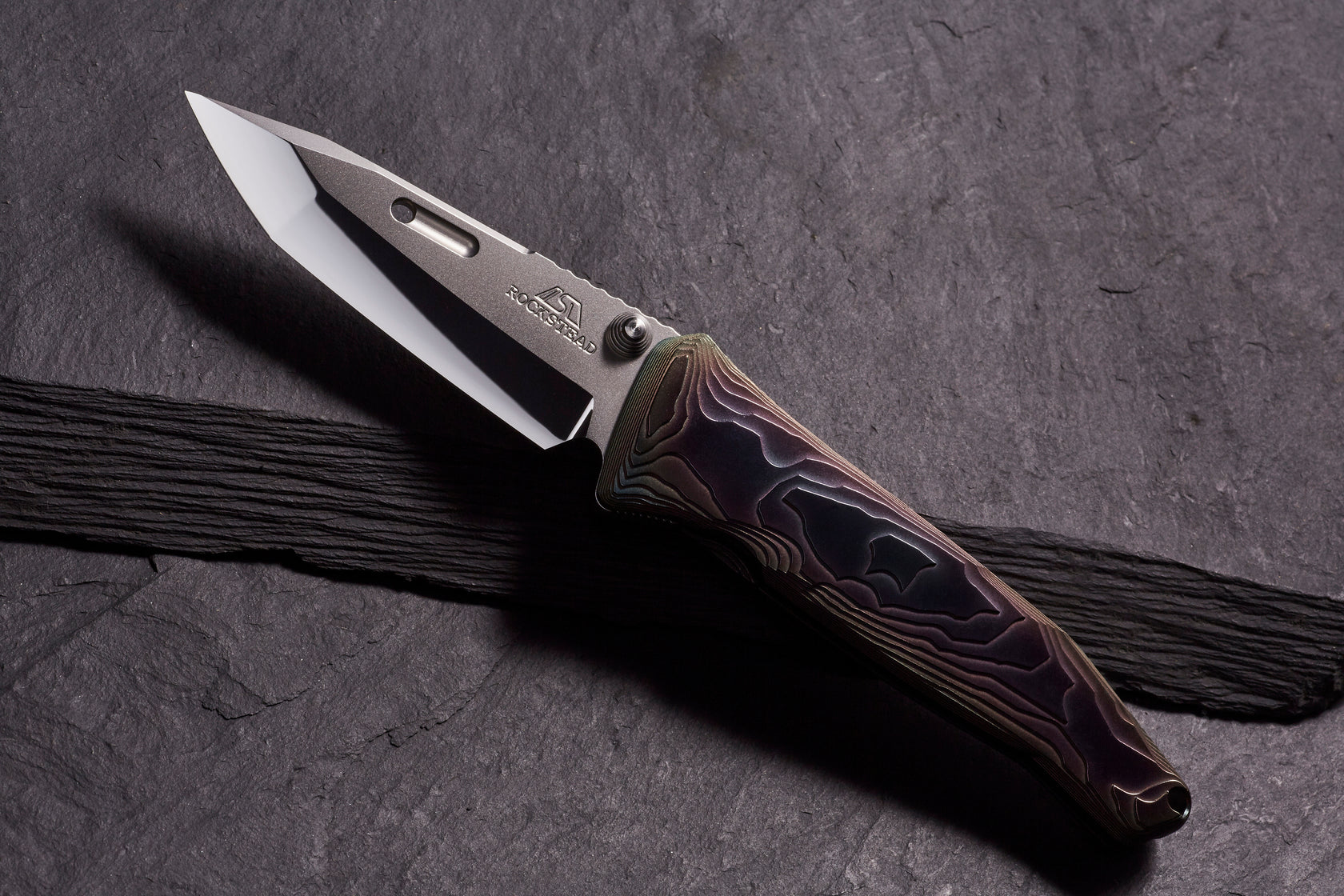
Friction Reduction via the Flawless Mirror Finish
Every Rockstead ZDP-189 blade undergoes a grueling manual polishing sequence performed by highly skilled craftsmen. The steel is worked down through progressive grits of abrasive papers and diamond pastes until it achieves a completely distortion-free mirror finish.
While visually spectacular, this finish is fundamentally an ergonomic and structural performance enhancement.
Polishing the blade to an optically flat plane entirely eliminates the microscopic valleys, tool marks, and grinding scratches left by manufacturing machines. These tiny surface imperfections are typically where moisture and corrosive elements pool, leading to rust. Because ZDP-189 has its chromium bound tightly into carbides, it functions as a semi-stainless steel.
By removing all surface micro-crevices, Rockstead denies corrosion a place to take root, giving the blade superb stain resistance. Furthermore, an incredibly smooth mirrored surface encounters significantly less physical resistance when moving through material, maximizing the raw cutting efficiency of the steel.
Maintenance and the Ultimate Factory Restoration
The primary obstacle to owning an ultra-hard 67 HRC knife is maintenance. Attempting to sharpen a zero-grind convex edge on standard flat sharpening stones or guided angle kits at home will inevitably scratch the pristine mirror finish and distort the precise convex geometry.
Rockstead elegantly solves this anxiety by providing an unparalleled Lifetime Factory Sharpening and Restoration Service for original owners.
Every authentic Rockstead knife is laser-engraved with a unique registration code. When your ZDP-189 edge eventually drops below peak performance after extended months of demanding use, you simply register the tool and ship it back to their specialized workshop in Japan. Rockstead’s own master craftsmen will place the blade back onto their custom grinding wheels, fully re-establishing the perfect Honzukuri geometry, re-polishing the mirror finish to its original distortion-free state, and returning the knife to you in absolute factory-mint condition.

Final Verdict: Is 67 HRC ZDP-189 Worth It?
Rockstead’s ZDP-189 steel hardened to 67 HRC represents the absolute technological peak of modern edge retention and powder metallurgy. It is not designed for the casual user who views a knife as a disposable utility tool.
Instead, it is engineered for the premium buyer, the high-end collector, and the advanced EDC enthusiast who demands the absolute limit of mechanical perfection. If you value an edge that completely defies standard wear cycles, values historical Japanese sword geometry, and appreciates a lifetime factory restoration safety net, Rockstead's 67 HRC ZDP-189 steel stands entirely alone as the undisputed apex predator of the knife world.