
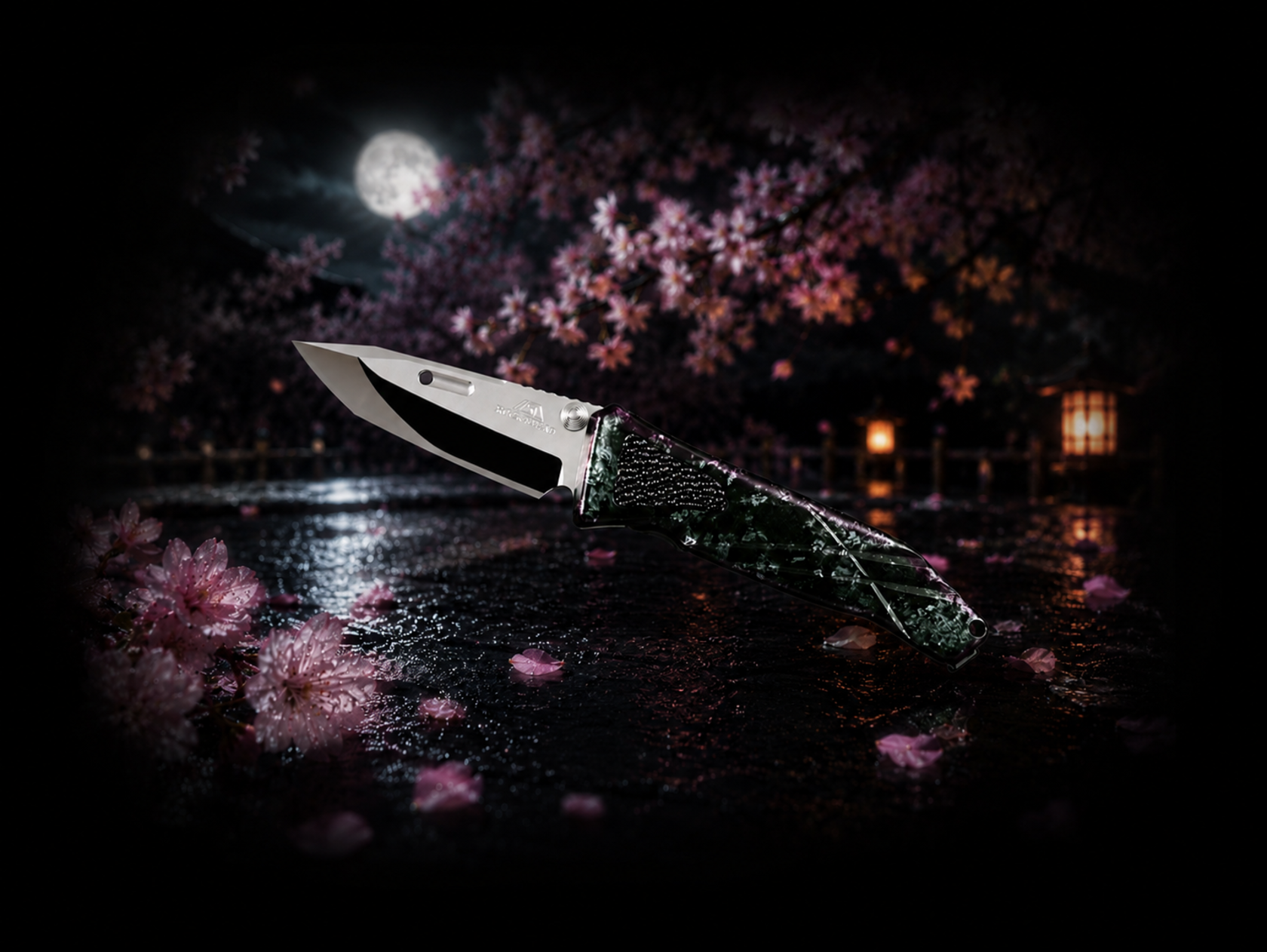
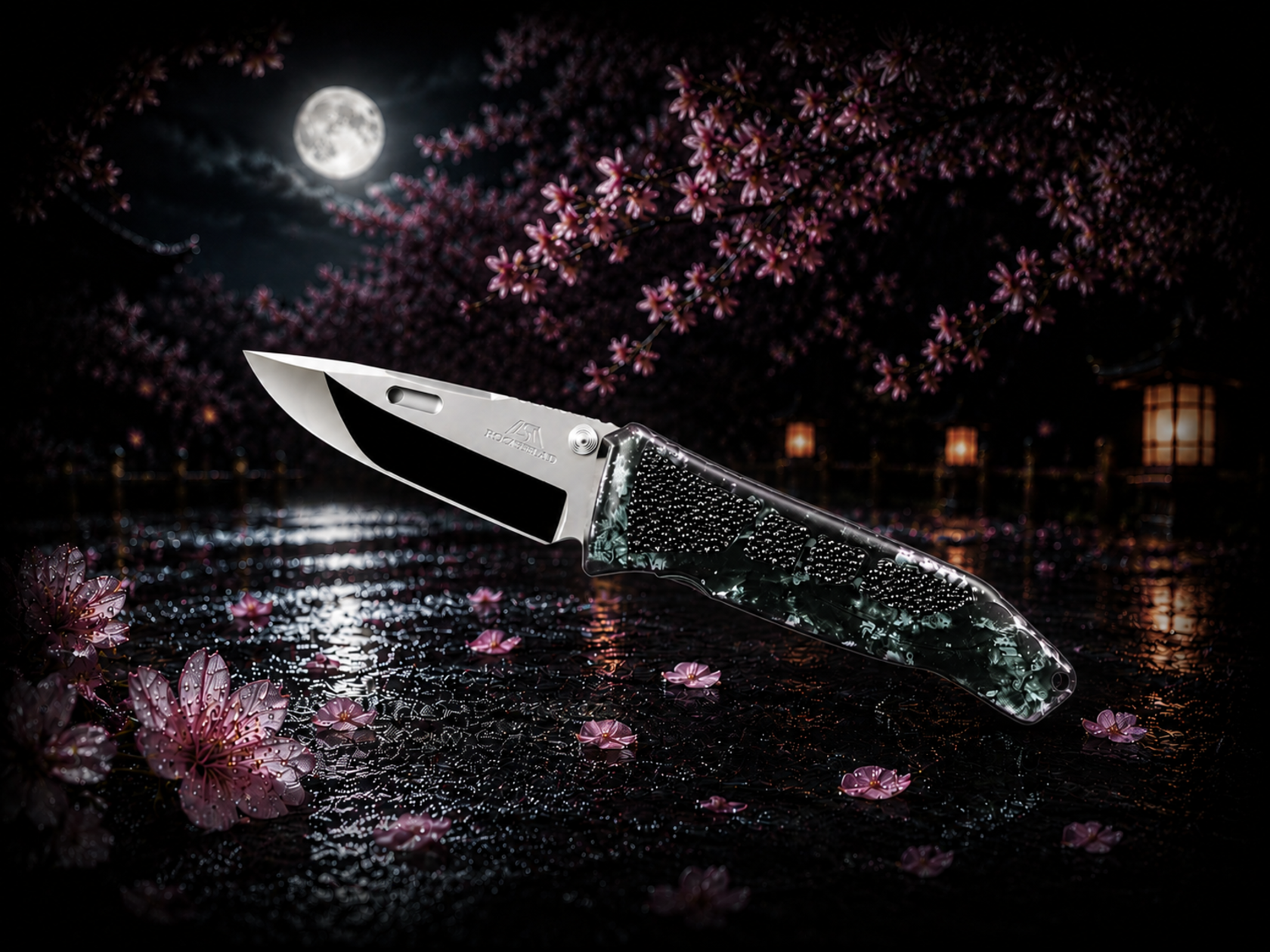
If you look closely at the upper echelons of premium EDC (everyday carry) gear, you will eventually find a benchmark that standard production tools simply cannot reach. Operating out of Osaka, Japan, Rockstead does not merely sharpen knives—they manipulate raw physics to create edges that defy common utility limitations. Their highly coveted Rockstead YOZAKURA limited edition series has captured the fascination of serious global collectors, not only for its striking cultural handle design but for its mind-bending cutting performance. To truly understand why the Rockstead Yozakura Honzukuri Mirror Polished Blade is so impossibly sharp, one must dissect the advanced metallurgy, ancient sword geometries, and sub-micron finishing steps hidden inside their workshop.

The Core Catalyst: ZDP189 Clad Steel
The foundation of any legendary edge begins at the atomic level within the steel matrix itself. Standard premium pocket knives usually employ high-end particle steels hardened to a maximum range of 60 to 62 HRC. Rockstead completely shatters this conventional limit by pushing their signature ZDP189 powder metallurgy core steel to a staggering hardness of approximately 67 HRC.
Because an isolated blade hardened uniformly to 67 HRC would become brittle and highly susceptible to snapping under lateral impact, Rockstead utilizes a specialized three-layer clad steel lamination process. By sandwiching the ultra-hard ZDP189 cutting core permanently between two outer layers of flexible, highly resilient VG10 stainless steel, the blade gains immense structural elasticity while allowing the exposed cutting apex to retain its terrifying sharpness exponentially longer than standard tools.
1. The Geometry Matrix: The Honzukuri Convex Edge
Most commercial folding knives utilize a flat or hollow grind that culminates in a distinct, V-shaped secondary cutting bevel. While simple to produce on an assembly line, this secondary bevel creates an abrupt "shoulder" behind the apex, which increases material drag and causes the blade to wedge or bind during deep cuts.
Rockstead bypasses this limitation entirely by implementing their iconic Honzukuri convex grind. Derived directly from the traditional cross-section of ancient Japanese samurai swords, the Honzukuri profile features a continuously smooth, sweeping curve that flows uninterrupted from the blade spine all the way down to the cutting edge.
When you slide the blade through heavy cardboard, leather, or rope, this convex geometry pushes materials smoothly apart with minimal resistance. By eliminating the friction-heavy shoulder of a standard bevel, the cutting force required from your hand drops to nearly zero.
2. Eliminating Friction: The Art of the Mirror Polish
The blinding, reflection-grade mirror polished finish of a Rockstead blade is not merely a luxury cosmetic statement. It is a critical performance element engineered to maximize edge longevity and cross-sectional slipperiness.
Under a high-powered microscope, a standard factory knife edge looks like a jagged serrated saw, filled with tiny grinding scratches, valleys, and tool marks. When that knife slices a tough medium, those microscopic imperfections act as stress points where the steel begins to bend, chip, or warp.
To eliminate this vulnerability, Japanese master artisans hand-polish every single Yozakura blade surface through a rigorous progression of finer abrasive compounds. They continue this painstaking manual process until the surface roughness measures an unbelievable 34 nanometers. By smoothing away every microscopic tool mark, moisture has nowhere to hide, creating immense natural corrosion resistance. More importantly, the glass-like surface slides through material with zero friction, protecting the microscopic edge apex from premature rolling or dulling.
3. Unyielding Alignment via the Heavy-Duty Liner Lock
A razor-sharp apex loses its effectiveness if the knife's frame flexes or wobbles during a demanding cutting task. To guarantee that the Honzukuri edge remains perfectly aligned with your hand's downward force, the Yozakura series utilizes an overbuilt internal liner lock system.
Rockstead rejects thin, stamped sheet metal liners; the lock bar inside these tools is remarkably thick, perfectly tensioned, and explicitly radiused at the contact point to prevent sticky lock engagement. When deployed, it clicks shut with a distinctive mechanical sound, providing an absolute vault-like framing with zero vertical or horizontal blade play.
The Reality of Ownership: Maintenance Realities
For the elite enthusiast investing in a piece of this caliber, the return on investment is immediately clear. Thanks to the 67 HRC convex apex and mirror finish, a Rockstead can withstand months of heavy cutting chores without ever needing a touch-up on a sharpening stone.
However, because the steel matrix is so exceptionally hard, attempting to re-sharpen a dulled Honzukuri edge at home using standard flat stones can easily ruin the precise convex geometry. To support their users, Rockstead provides a dedicated factory sharpening and refurbishment service for registered original owners, shipping the knife back to Osaka to be restored to a factory-fresh mirror polish.
The Ultimate Verdict
The extreme sharpness of the Rockstead Yozakura Honzukuri blade is the direct result of a refusal to cut corners. By fusing an ultra-hard 67 HRC ZDP189 clad steel core with an ancestral convex sword geometry and hand-buffing it to a frictionless mirror finish, Rockstead has elevated pocket cutlery into the realm of functional art. It is a defining masterpiece that delivers a level of cutting physics, edge durability, and engineering pride that few other pocket tools on earth can ever hope to emulate.