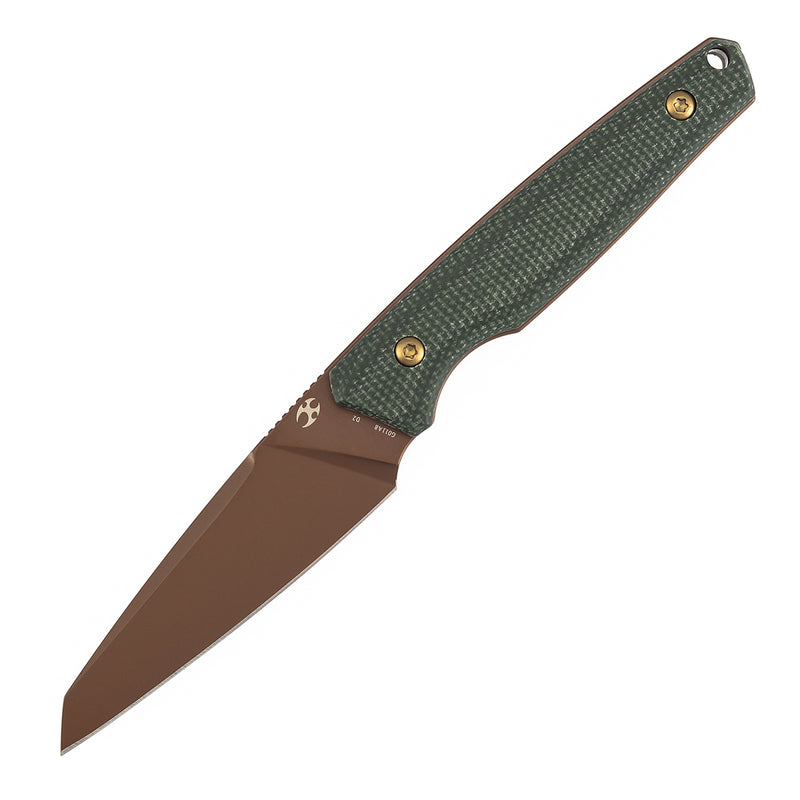
When transitioning to a compact fixed blade for daily carry, understanding its exact physical dimensions is the single most important factor before making a purchase. A knife can look incredibly sleek in high-resolution product photos, but the real test is how it coexists with your keys, smartphone, and wallet. The Kansept Parr, conceptualized by Canadian custom designer Jonathan Styles and precision-built by Kansept, has emerged as a frontrunner in the modern EDC market. It aims to offer the raw structural integrity of a full-tang fixed blade while completely mimicking the low-profile pocket footprints traditionally reserved for folding knives.
To give you an exact understanding of its pocket presence and hand leverage, we have lined the model up against three of the industry's most popular compact knives. Let’s see how its geometry stacks up side-by-side.

The Structural Baseline
Before introducing the comparison models, let us establish the exact physical footprint of Jonathan Styles' design:
-
Total Overall Length: 6.38 inches (162 mm)
-
Blade Length: 3.12 inches (79.2 mm)
-
Spine Thickness: 0.137 inches (3.5 mm)
-
Bare Knife Weight: 2.34 ounces (66.3 grams)
With a total thickness that remains under half an inch when combined with its custom-molded Kydex sheath, it sits incredibly flat against your body.
Comparison 1: Kansept Parr vs. Benchmade Bugout 535
The Folding Lightweight Benchmark
The Benchmade Bugout is widely recognized as the industry standard for lightweight, ultra-thin folding knives. Placing them side-by-side yields some fascinating geometric trade-offs.
-
Length & Pocket Footprint: When open, the Bugout is over an inch longer overall (7.46"). However, when the Bugout is closed (4.22"), it occupies a wider footprint in the corner of your pocket. The Parr, riding vertically inside its slim sheath, takes up less total horizontal pocket space.
-
Blade Robustness: The Bugout utilizes a very thin 0.090" blade spine meant for delicate slicing. The Parr features a much beefier 0.137" spine. It provides a level of structural rigidity and lateral strength that the Bugout’s lightweight folding frame simply cannot replicate.
-
The Verdict: If you prioritize extreme slicing geometry and a folding mechanism, the Bugout wins. If you want a tougher blade spine with no moving parts that occupies similar pocket real estate, the Parr takes the crown.
Comparison 2: Kansept Parr vs. ESEE Izula
The Hard-Use Survival Compact
The ESEE Izula is a legendary minimalist fixed blade built for survival and heavy-duty field abuse. While both fall into the compact fixed blade category, their design philosophies are completely different.
-
Ergonomics & Handle Profile: The Izula features a shorter overall length (6.25") but a noticeably blockier, wider handle grip profile. The Parr is slightly longer (6.38") but uses highly refined, 3D-machined chamfers along its premium scale borders. This makes the Parr significantly more comfortable for extended slicing tasks, completely eliminating the hot spots that the Izula can cause on bare skin.
-
Cutting Performance: The Izula utilizes a thick, robust drop point with a coated finish, which can bind when slicing through heavy cardboard. The Parr utilizes a high flat grind paired with a modified reverse tanto tip, making it a drastically more efficient precision slicer for daily urban tasks.
-
The Verdict: The Izula remains a great bulletproof choice for a wilderness survival tin, but the Parr is vastly superior as a refined, comfortable daily pocket companion.
Comparison 3: Kansept Parr vs. Spyderco Para 3 Lightweight
The Urban Utility Standard
The Spyderco Para 3 LW is celebrated for its incredible ergonomics and high-performance slicing capability.
-
Hand Purchase: The Para 3 LW uses a deep index-finger choil that forces a highly secure four-finger grip, but it requires a very wide handle frame to achieve this. The Parr achieves a highly secure three-and-a-half-finger grip via an elegant forward finger guard, keeping its total width exceptionally narrow and sleek.
-
Weight Distribution: Despite being a solid full-tang piece of steel, the Parr (2.34 oz) actually weighs less than the Para 3 LW (2.40 oz). It delivers an incredibly balanced, weightless feel when tucked behind a waistband or dropped into a front pocket.
-
The Verdict: If you have exceptionally large hands and require a wide, sprawling handle, the Spyderco is tough to beat. However, if you want a lighter, narrower tool that carries completely flat without expanding your pocket line, the Parr is the clear winner.

The Final Dimensions Matrix
To summarize how these tools match up mechanically, refer to the comparative reference matrix below:
| Knife Model | Total Length | Spine Thickness | Structural Style | Pocket Profile |
| Kansept Parr | 6.38" | 0.137" | Full-Tang Fixed | Ultra-Slim / Flat |
| Benchmade Bugout | 7.46" | 0.090" | Axis Folder | Wide / Flat |
| ESEE Izula | 6.25" | 0.156" | Skeletonized Fixed | Short / Blocky |
| Spyderco Para 3 LW | 7.24" | 0.145" | Compression Folder | Very Wide / Bulbous |
Ultimately, Jonathan Styles balanced these dimensions perfectly. The knife successfully occupies the middle ground—delivering the indestructible confidence of a fixed blade with the effortless pocket comfort of a streamlined folder.