If you have spent any time in the high-end custom or mid-tech knife community, you have inevitably encountered the mystical reputation of Rockstead. Operating out of Sakai, Japan—an epicenter of traditional blacksmithing for over half a millennium—Rockstead creates cutting tools that border on optical and structural perfection.
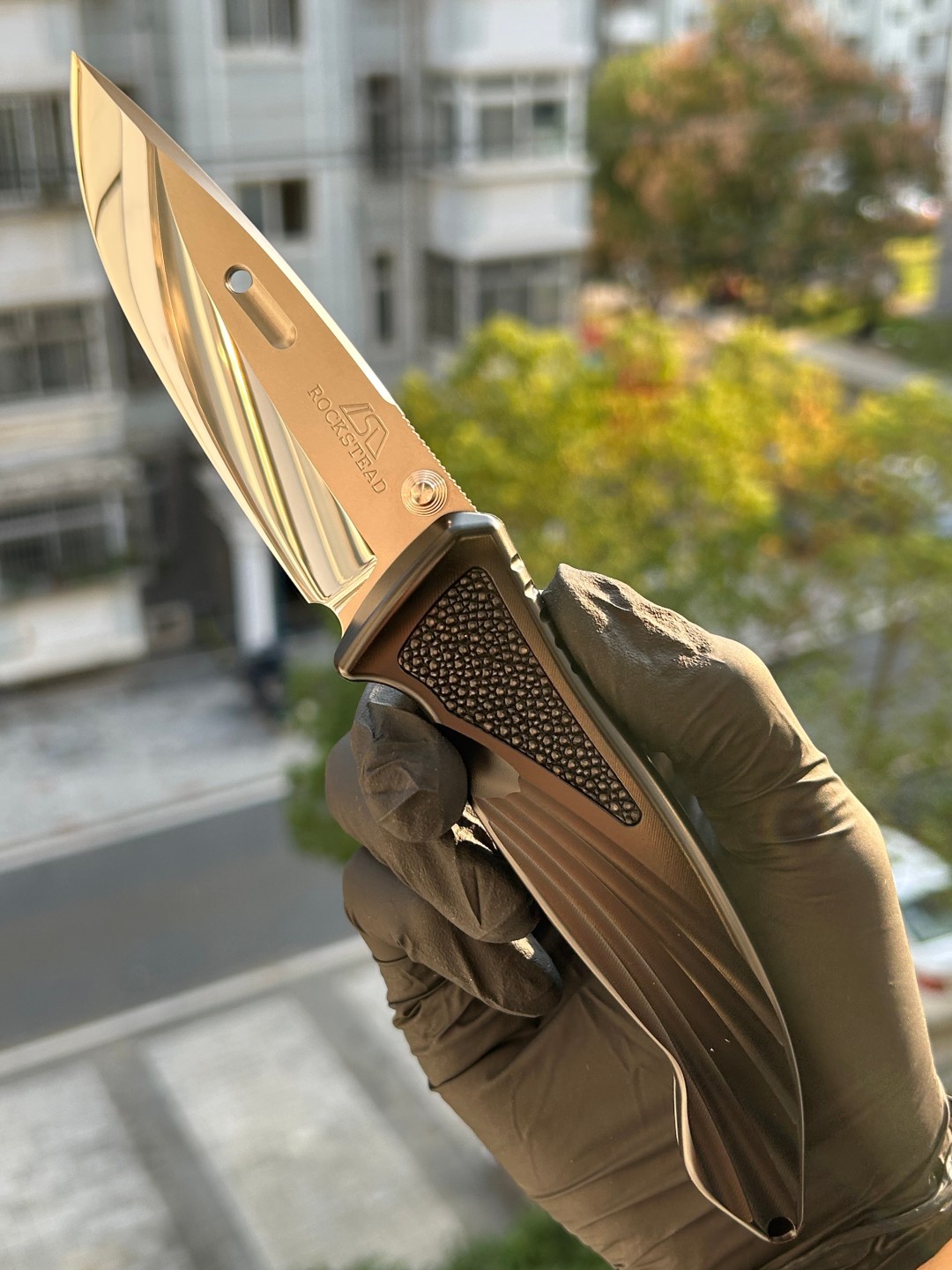
Among their elite folders, the Rockstead Shin stands tall. Named after the Japanese character for trust or faith (信), it promises an edge that defies standard metallurgical limits. But when a pocket knife carries a price tag North of $1,300, it cannot just rely on legendary mythos. It needs to perform under real-world conditions.
In this comprehensive Rockstead Shin review, we will tear down the specs, look closely at the advanced metallurgy, analyze real pocket performance, and determine if this legendary liner lock is truly worth the luxury investment.
Visual & Structural First Impressions
The moment you pull the Shin out of its traditional paulownia wood box, your eye is immediately drawn to the blade. It features a mirror polish so flawless that it looks smooth even under high magnification. Unlike standard factory grinds that show faint parallel abrasive lines, the Shin reflects an absolute, undisturbed image.
In hand, the knife feels incredibly solid. At roughly 5.11 ounces (145 grams), it has a reassuring, deliberate heft. The tolerances are stunningly tight; there is absolutely zero side-to-side play or vertical slip, and the blade locks up with a crisp, authoritative metallic click.
The Heart of the Shin: Honzukuri Grind & Premium Metallurgy
What separates a Rockstead from other tier-one knives like Chris Reeve or Shirogorov is the geometry of the cutting edge. The Shin features a Honzukuri grind.
This profile mimics the traditional cross-section of a Japanese katana, using a continuous convex curve from the spine down to the zero-ground edge. By eliminating a secondary accent bevel, the shoulders of the blade stay thick and structurally robust. When slicing through dense materials like heavy cardboard, thick rope, or wood, the convex shape naturally wedges the material apart, preventing the blade from catching or binding.
Rockstead accomplishes this with two radically different, ultra-premium steel configurations.
Material Configuration Breakdown
| Performance Attribute | Rockstead Shin ZDP | Rockstead Shin DLC (Legacy Variant) |
| Core Steel Composition | ZDP-189 (Clad in VG-10 Stainless) | YXR7 (High-Speed Matrix Tool Steel) |
| Target Hardness (HRC) | ~67 HRC | ~65 HRC |
| External Blade Coating | Uncoated Mirror Polish | Diamond-Like Carbon (DLC) Over Mirror |
| Corrosion Resistance | Extremely High (High-Chromium Powder) | Moderate (Requires periodic oiling) |
| Edge Retention Style | Unmatched structural crispness | High impact resistance and micro-chipping protection |
For daily users who want maximum stainless properties, the ZDP-189 variant is a masterclass in modern metallurgy. The ultra-hard core is sandwiched between tough VG-10 steel, ensuring the knife holds its edge for months on end under normal cutting conditions.
Handle Ergonomics & Pocket Carry Dynamics
The handle on the Shin is machined from thick slabs of A6063S duraluminum finished with a hard-anodized black coating. A pleasant wave pattern is milled along the top portion of the frame, providing subtle texture without introducing abrasive hot spots.
The defining feature of the handle layout is the genuine stingray skin (Samé) inlay on the presentation side. Aside from providing a historical nod to traditional Japanese handle wraps, the natural pearled nodules of ray skin provide an incredible tactile grip. It feels remarkably secure even if your hands are wet or oily.
The Pocket Clip & Mechanical Deployment
The pocket clip is securely recessed into a dedicated milled pocket, meaning it will never shift or rotate out of alignment during heavy use. It offers a solid, firm spring tension that keeps the knife anchored in place.
Deploying the Shin is an intentional, hydraulic experience. Rather than swinging freely on ceramic bearings like modern flippers, the Shin rotates on large, ultra-precise phosphor bronze washers. The deployment via the single right-handed thumb stud is incredibly smooth—often described by enthusiasts as "hydraulic fluid" or "buttery smooth." It doesn't drop shut mechanically, but it glides open with flawless consistency.
The Verdict: Is the Rockstead Shin Worth It?
The Rockstead Shin is not a knife designed for casual value seekers. If you want a basic tool to open envelopes, an entry-level pocket folder will do fine.
However, if you appreciate mechanical perfection, custom tolerances, historical Japanese craftsmanship, and exotic metallurgy pushed to extreme limits, the Shin is in a category entirely of its own. It successfully bridges the gap between an elite, heirloom-grade art piece and a rugged, hard-use workhorse.
Frequently Asked Questions (FAQ)
Can I sharpen the Rockstead Shin myself?
You should avoid standard flat whetstones, pull-through sharpeners, or standard guided rod systems entirely. Because the Honzukuri edge is a continuous convex curve with zero secondary bevels, flat stones will flatten the edge and ruin both the finish and cutting dynamics. For routine maintenance at home, strop the blade lightly using a smooth leather or denim strop loaded with high-grade diamond paste. For a complete edge restoration, you can register the knife and send it back to Rockstead’s workshop in Japan for their professional lifetime factory sharpening.
Why does Rockstead use a clad steel approach for the ZDP-189 model?
ZDP-189 is an incredibly advanced powder metallurgy stainless steel packed with carbon and chromium. When pushed to an extreme hardness of 67 HRC, it becomes exceptionally rigid. To prevent the blade from being overly brittle under side-loads, Rockstead clads the hard ZDP-189 core between layers of highly resilient VG-10 stainless steel. This gives you the ultimate combination: the absolute best edge retention in the world at the apex, backed by structural flexibility and shock absorption.
Does the black anodized handle scratch easily?
The handle slabs are made from hard-anodized A6063S duraluminum. While the hard-anodizing layer is incredibly tough and resists superficial scuffs and keys in your pocket, like any coated aluminum, it will eventually develop honest pocket wear and "silver" along the sharp corners if dragged against abrasive surfaces. This gives the tool a beautiful, broken-in look over years of regular carry.
Is the Shin comfortable for left-handed users?
The Rockstead Shin is optimized specifically for right-handed users. The single thumb stud is placed on the left side of the blade for right-thumb deployment, and the pocket clip is strictly configured for right-hand tip-up carry. Additionally, the liner lock mechanism operates from left to right, making it a bit cumbersome to unlock single-handedly with the left hand.